Pearson+ LogoPearson+ Logo
Ch. 1 - The Molecular Basis of Heredity, Variation, and Evolution
Sanders - Genetic Analysis: An Integrated Approach 3rd Edition
Sanders3rd EditionGenetic Analysis: An Integrated ApproachISBN: 9780135564172Not the one you use?Change textbook
Chapter 1, Problem 20a

The following segment of DNA is the template strand transcribed into mRNA:
   5'-...GACATGGAA...-3'
What is the sequence of mRNA created from this sequence?

Verified step by step guidance
1
Identify the direction of the DNA template strand. The given DNA template strand is 5'-...GACATGGAA...-3'. Remember that transcription occurs in the 5' to 3' direction of the mRNA, which is complementary to the 3' to 5' direction of the DNA template strand.
Determine the complementary base pairing rules for transcription. In RNA, adenine (A) pairs with uracil (U), thymine (T) pairs with adenine (A), cytosine (C) pairs with guanine (G), and guanine (G) pairs with cytosine (C).
Using the base pairing rules, transcribe the DNA template strand into the mRNA sequence. For each base in the DNA template strand, write the complementary RNA base. For example, G in the DNA pairs with C in the RNA, A in the DNA pairs with U in the RNA, and so on.
Reverse the sequence of the transcribed mRNA to ensure it is written in the 5' to 3' direction, as mRNA is synthesized in this orientation during transcription.
Write the final mRNA sequence in the 5' to 3' direction, ensuring that all bases are correctly transcribed and oriented.

Verified video answer for a similar problem:

This video solution was recommended by our tutors as helpful for the problem above.
Video duration:
1m
Was this helpful?

Key Concepts

Here are the essential concepts you must grasp in order to answer the question correctly.

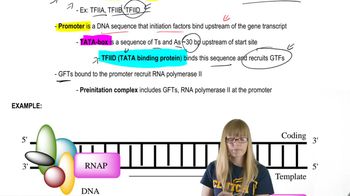
Transcription

Transcription is the process by which the genetic information in DNA is copied into messenger RNA (mRNA). During this process, RNA polymerase binds to the DNA template strand and synthesizes a complementary RNA strand. The RNA is synthesized in the 5' to 3' direction, meaning that the RNA strand will have a sequence that is complementary to the DNA template strand.
Recommended video:
Guided course
09:16
Eukaryotic Transcription

Base Pairing Rules

Base pairing rules dictate how nucleotides pair in DNA and RNA. In DNA, adenine (A) pairs with thymine (T), and cytosine (C) pairs with guanine (G). However, in RNA, uracil (U) replaces thymine, so adenine pairs with uracil. Understanding these rules is essential for determining the correct mRNA sequence from a given DNA template.
Recommended video:
Guided course
03:49
Base Distortions

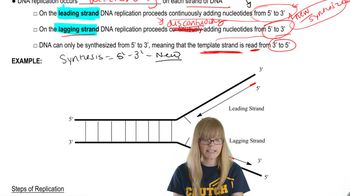
5' to 3' Directionality

Nucleic acids, including DNA and RNA, have directionality, indicated as 5' and 3' ends. The 5' end has a phosphate group, while the 3' end has a hydroxyl group. During transcription, RNA is synthesized in the 5' to 3' direction, meaning that the RNA strand will be complementary to the DNA template strand and will start from the 3' end of the DNA template.
Recommended video:
Guided course
05:02
Directionality