Pearson+ LogoPearson+ Logo
Ch.2 Chemistry and Measurements
Timberlake - Chemistry: An Introduction to General, Organic, and Biological Chemistry 13th Edition
Timberlake13th EditionChemistry: An Introduction to General, Organic, and Biological ChemistryISBN: 9780134421353Not the one you use?Change textbook
Chapter 2, Problem 35c

Write the numerical value for each of the following prefixes:
c. milli

Verified step by step guidance
1
Understand that prefixes in chemistry are used to represent powers of ten, making it easier to express very large or very small numbers.
Recall that the prefix 'milli-' is commonly used in the metric system and represents a factor of 10^-3.
Write the numerical value for 'milli-' as 0.001, which is equivalent to 10^-3.
Recognize that this means 1 millimeter (mm), for example, is 0.001 meters (m), or 1 milligram (mg) is 0.001 grams (g).
Use this knowledge to apply the 'milli-' prefix in various contexts, such as converting between units or interpreting measurements in scientific problems.

Verified video answer for a similar problem:

This video solution was recommended by our tutors as helpful for the problem above.
Video duration:
2m
Was this helpful?

Key Concepts

Here are the essential concepts you must grasp in order to answer the question correctly.

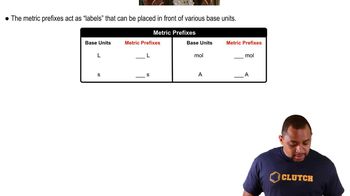
Metric Prefixes

Metric prefixes are standardized units of measurement that denote specific powers of ten. They are used to simplify the representation of large or small quantities in the metric system. For example, 'milli-' represents one-thousandth (10^-3) of a unit, making it easier to express measurements like millimeters or milliliters.
Recommended video:
Guided course
01:16
Metric Prefixes

Decimal Representation

Decimal representation is a way of expressing numbers using a base-10 system, which is fundamental in mathematics and science. Each digit in a decimal number has a place value that is a power of ten. Understanding how to convert metric prefixes into decimal form is essential for accurately interpreting measurements.
Recommended video:
Guided course
2:08
Molecular Representations Concept 1

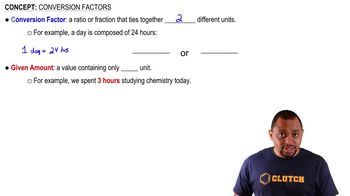
Unit Conversion

Unit conversion is the process of converting a quantity expressed in one unit to another unit. This is crucial in scientific calculations where different units are used. For instance, converting from meters to millimeters involves multiplying by 1,000, as 'milli-' indicates a factor of 1/1,000.
Recommended video:
Guided course
01:56
Conversion Factors (Simplified) Concept 1