Pearson+ LogoPearson+ Logo
Ch.14 Carboxylic Acids, Esters, Amines, and Amides
Timberlake - Chemistry: An Introduction to General, Organic, and Biological Chemistry 13th Edition
Timberlake13th EditionChemistry: An Introduction to General, Organic, and Biological ChemistryISBN: 9780134421353Not the one you use?Change textbook
Chapter 14, Problem 41c

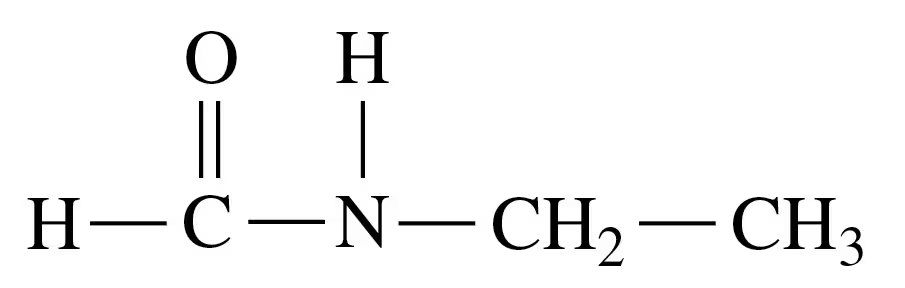
Write the IUPAC and common names, if any, for each of the following amides:
c. Structural formula of an amide showing carbon, nitrogen, and oxygen atoms with hydrogen and alkyl groups attached.

Verified step by step guidance
1
Identify the structure of the amide from the provided image. Amides are organic compounds characterized by the functional group RCONH2, where R is an alkyl or aryl group.
Determine the parent chain by identifying the longest continuous carbon chain that includes the carbonyl group (C=O). This chain will form the base name of the compound.
Name the parent chain by replacing the '-oic acid' or '-ic acid' suffix of the corresponding carboxylic acid with '-amide'. For example, if the parent chain is derived from ethanoic acid, the name becomes ethanamide.
If there are substituents attached to the nitrogen atom (N), indicate them as prefixes with the letter 'N-' before the substituent name. For example, if there is a methyl group attached to the nitrogen, it would be written as 'N-methyl'.
Combine the names of the substituents and the parent chain to form the full IUPAC name. If the compound has a common name, identify it based on traditional naming conventions (e.g., acetamide for ethanamide).

Verified video answer for a similar problem:

This video solution was recommended by our tutors as helpful for the problem above.
Video duration:
3m
Was this helpful?

Key Concepts

Here are the essential concepts you must grasp in order to answer the question correctly.

IUPAC Nomenclature

IUPAC nomenclature is a systematic method for naming chemical compounds, ensuring that each name conveys specific information about the structure of the molecule. For amides, the IUPAC name typically includes the suffix '-amide' and is derived from the corresponding carboxylic acid by replacing the '-oic acid' ending with '-amide'. Understanding this system is crucial for accurately identifying and naming amides.
Recommended video:
Guided course
3:18
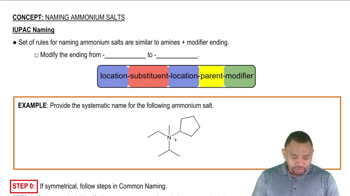
IUPAC Naming Concept 3

Amides

Amides are organic compounds derived from carboxylic acids, where the hydroxyl group (-OH) is replaced by an amine group (-NH2, -NHR, or -NR2). They are characterized by the presence of a carbonyl group (C=O) adjacent to the nitrogen atom. Amides play significant roles in biological systems and are commonly found in proteins and pharmaceuticals, making their identification and naming important in organic chemistry.
Recommended video:
Guided course
1:03
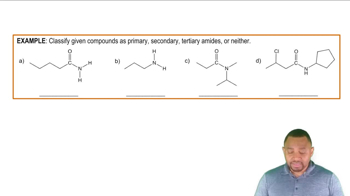
Intro to Amides Example 1

Common Names

Common names are informal names used in chemistry that may not follow systematic naming conventions but are widely recognized and accepted. For amides, common names often derive from the parent carboxylic acid, sometimes using the prefix 'N-' to indicate substituents on the nitrogen. Familiarity with common names is essential for effective communication in chemistry, especially when discussing well-known compounds.