Pearson+ LogoPearson+ Logo
Ch.2 Chemistry and Measurements
Timberlake - Chemistry: An Introduction to General, Organic, and Biological Chemistry 13th Edition
Timberlake13th EditionChemistry: An Introduction to General, Organic, and Biological ChemistryISBN: 9780134421353Not the one you use?Change textbook
Chapter 2, Problem 38d

Use a prefix to write the name for each of the following:
d. 10-12 m

Verified step by step guidance
1
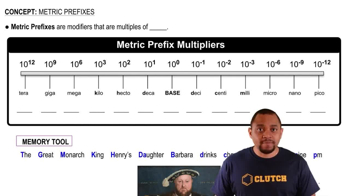
Identify the prefix that corresponds to the factor 10⁻¹². In the International System of Units (SI), the prefix for 10⁻¹² is 'pico-' (symbol: p).
Combine the prefix 'pico-' with the base unit 'meter' (m) to form the name of the measurement.
The resulting name for 10⁻¹² m is 'picometer'.

Verified video answer for a similar problem:

This video solution was recommended by our tutors as helpful for the problem above.
Video duration:
2m
Was this helpful?

Key Concepts

Here are the essential concepts you must grasp in order to answer the question correctly.

Prefix System in the Metric System

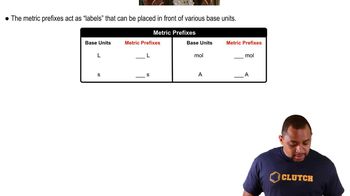
The metric system uses a series of prefixes to denote different powers of ten, making it easier to express large or small quantities. Each prefix corresponds to a specific factor, allowing for straightforward conversions and comparisons. For example, 'milli-' represents 10⁻³, while 'pico-' represents 10⁻¹².
Recommended video:
Guided course
01:16
Metric Prefixes

Pico

The prefix 'pico-' is used in the metric system to denote a factor of 10⁻¹², or one trillionth. It is commonly used in scientific contexts, such as measuring wavelengths of light or electrical charge, where extremely small quantities are involved. For instance, 1 picometer (pm) equals 10⁻¹² meters.
Recommended video:
Guided course
03:59
Metric Prefixes

Scientific Notation

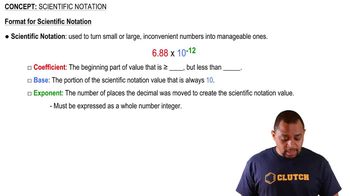
Scientific notation is a method of expressing numbers that are too large or too small in a more manageable form. It involves writing numbers as a product of a coefficient and a power of ten. For example, 10⁻¹² can be expressed as 1 x 10⁻¹², which simplifies calculations and comparisons in scientific work.
Recommended video:
Guided course
01:41
Scientific Notation