Pearson+ LogoPearson+ Logo
Ch.6 Ionic and Molecular Compounds
Timberlake - Chemistry: An Introduction to General, Organic, and Biological Chemistry 13th Edition
Timberlake13th EditionChemistry: An Introduction to General, Organic, and Biological ChemistryISBN: 9780134421353Not the one you use?Change textbook
Chapter 6, Problem 4e

State the number of electrons lost or gained when the following elements form ions:
e. Rb

Verified step by step guidance
1
Identify the group number of the element Rb (Rubidium) on the periodic table. Rubidium is in Group 1, which means it is an alkali metal.
Recall that elements in Group 1 typically lose one electron to achieve a stable electron configuration, similar to the nearest noble gas.
Write the electron configuration of a neutral Rb atom: Rb has an atomic number of 37, so its electron configuration is 1s² 2s² 2p⁶ 3s² 3p⁶ 4s² 3d¹⁰ 4p⁶ 5s¹.
Determine the change in electron configuration when Rb forms an ion. By losing one electron, the 5s¹ electron is removed, resulting in the configuration 1s² 2s² 2p⁶ 3s² 3p⁶ 4s² 3d¹⁰ 4p⁶, which matches the configuration of the noble gas krypton (Kr).
Conclude that Rb loses one electron to form a cation with a +1 charge (Rb⁺).

Verified video answer for a similar problem:

This video solution was recommended by our tutors as helpful for the problem above.
Video duration:
1m
Was this helpful?

Key Concepts

Here are the essential concepts you must grasp in order to answer the question correctly.

Ion Formation

Ion formation occurs when atoms gain or lose electrons to achieve a stable electron configuration, typically resembling that of the nearest noble gas. This process results in the creation of charged particles known as ions, which can be either cations (positively charged) or anions (negatively charged). Understanding how and why elements form ions is crucial for predicting their chemical behavior.
Recommended video:
Guided course
1:41
Amide Formation Concept 1

Group 1 Elements

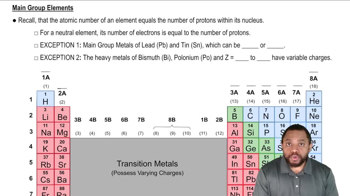
Rubidium (Rb) is a member of the alkali metals, which are found in Group 1 of the periodic table. These elements have one electron in their outermost shell, making them highly reactive and prone to losing that single electron to form cations with a +1 charge. Recognizing the properties of Group 1 elements helps in predicting the number of electrons they lose when forming ions.
Recommended video:
Guided course
07:38
Periodic Table: Main Group Element Charges Concept 2

Electron Configuration

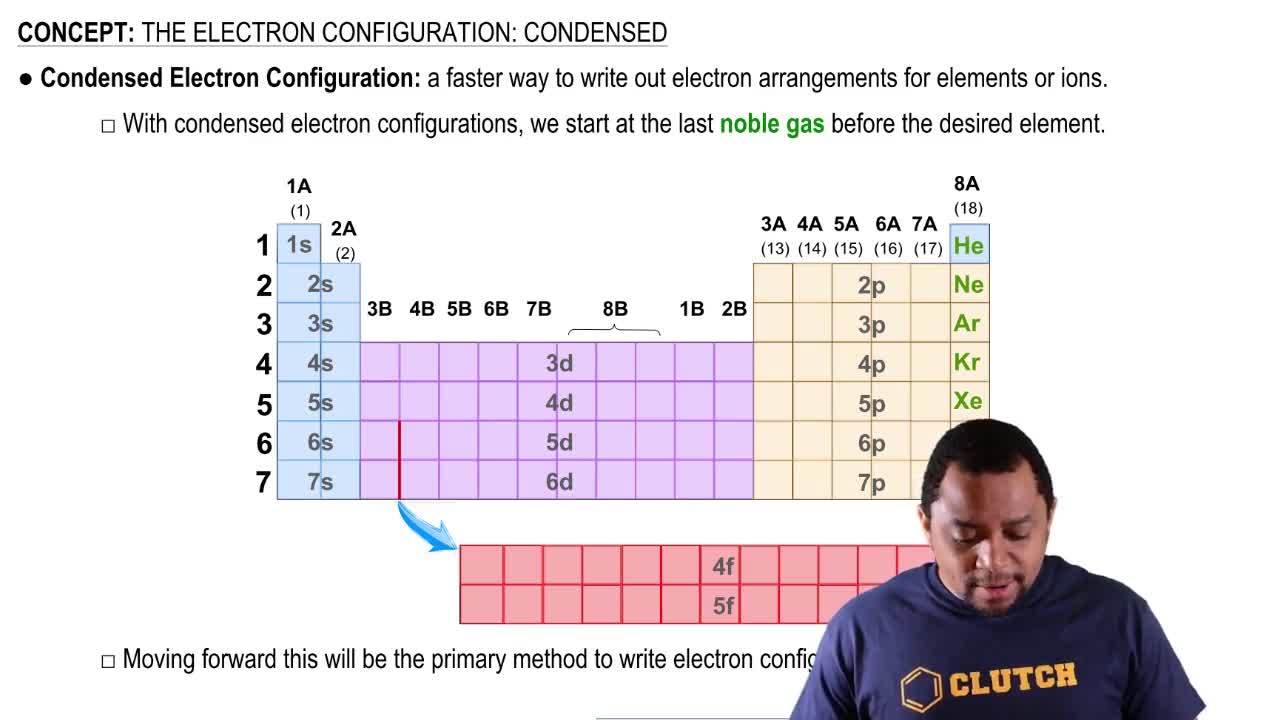
Electron configuration describes the distribution of electrons in an atom's orbitals. For rubidium, the electron configuration is [Kr] 5s¹, indicating it has one electron in its outermost shell. When rubidium forms an ion, it loses this single valence electron, resulting in a stable electron configuration similar to that of krypton, which is essential for understanding its ionic behavior.
Recommended video:
Guided course
01:08
The Electron Configuration: Condensed