
Pearson+ LogoPearson+ Logo
Ch.2 Chemistry and Measurements
Timberlake - Chemistry: An Introduction to General, Organic, and Biological Chemistry 13th Edition
Timberlake13th EditionChemistry: An Introduction to General, Organic, and Biological ChemistryISBN: 9780134421353Not the one you use?Change textbook
Chapter 2, Problem 14

Indicate if the zeros are significant in each of the following measurements:
a. 20.05 °C
b. 5.00 m
c. 0.000 02 g
d. 120 000 yr
e. 8.05 × 10² L

Verified step by step guidance
1
Step 1: Understand the rules for determining significant figures. Zeros are significant if they are (a) between nonzero digits, (b) at the end of a number with a decimal point, or (c) in scientific notation as part of the coefficient. Leading zeros (zeros before the first nonzero digit) are not significant, and trailing zeros in a number without a decimal point are ambiguous unless specified.
Step 2: Analyze part (a) 20.05 °C. The zeros are between nonzero digits, so they are significant. This measurement has four significant figures.
Step 3: Analyze part (b) 5.00 m. The zeros are at the end of the number and there is a decimal point, so they are significant. This measurement has three significant figures.
Step 4: Analyze part (c) 0.000 02 g. The leading zeros (zeros before the first nonzero digit) are not significant. Only the '2' is significant, so this measurement has one significant figure.
Step 5: Analyze parts (d) and (e). For (d) 120 000 yr, the trailing zeros are ambiguous because there is no decimal point, so it is unclear how many are significant. For (e) 8.05 x 10² L, the zero is between nonzero digits, so it is significant. This measurement has three significant figures.

Verified video answer for a similar problem:

This video solution was recommended by our tutors as helpful for the problem above.
Video duration:
7m
Was this helpful?

Key Concepts

Here are the essential concepts you must grasp in order to answer the question correctly.

Significant Figures

Significant figures are the digits in a number that contribute to its precision. This includes all non-zero digits, any zeros between significant digits, and trailing zeros in the decimal portion. Understanding significant figures is crucial for determining which zeros in a measurement are significant, as they indicate the precision of the measurement.
Recommended video:
Guided course
01:09
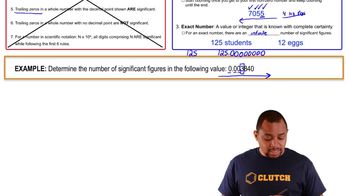
Significant Figures (Simplified) Example 2

Leading Zeros

Leading zeros are the zeros that precede all non-zero digits in a number. They are not considered significant because they do not affect the value of the number. For example, in the measurement 0.000 02 g, the leading zeros are not significant, while the '2' is significant.
Recommended video:
Guided course
04:40
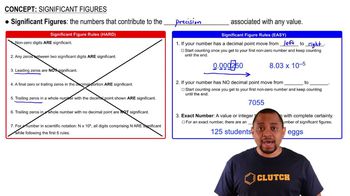
Significant Figures (Simplified) Concept 2

Trailing Zeros

Trailing zeros are the zeros that follow non-zero digits in a number. Their significance depends on the presence of a decimal point. In a measurement like 20.05 °C, all zeros are significant, while in a whole number without a decimal, such as 120,000 yr, the trailing zeros may not be significant unless specified otherwise.
Recommended video:
Guided course
04:40
Significant Figures (Simplified) Concept 2