Pearson+ LogoPearson+ Logo
Ch.14 Carboxylic Acids, Esters, Amines, and Amides
Timberlake - Chemistry: An Introduction to General, Organic, and Biological Chemistry 13th Edition
Timberlake13th EditionChemistry: An Introduction to General, Organic, and Biological ChemistryISBN: 9780134421353Not the one you use?Change textbook
Chapter 14, Problem 11c

Write the balanced chemical equation for the reaction of each of the following carboxylic acids with NaOH:
c. benzoic acid

Verified step by step guidance
1
Step 1: Identify the chemical formula of benzoic acid. Benzoic acid is a carboxylic acid with the formula C₆H₅COOH.
Step 2: Recognize the reaction type. Benzoic acid reacts with NaOH (sodium hydroxide) in a neutralization reaction, where the carboxylic acid donates a proton (H⁺) to the hydroxide ion (OH⁻). This forms water (H₂O) and a salt.
Step 3: Write the reactants. The reactants are benzoic acid (C₆H₅COOH) and sodium hydroxide (NaOH).
Step 4: Write the products. The products of the reaction are sodium benzoate (C₆H₅COONa) and water (H₂O). Sodium benzoate is the salt formed when the hydrogen atom from the carboxylic acid group is replaced by a sodium ion (Na⁺).
Step 5: Write the balanced chemical equation. Combine the reactants and products into a balanced equation: C6H5COOH+NaOHC6H5COONa+H2O.

Verified video answer for a similar problem:

This video solution was recommended by our tutors as helpful for the problem above.
Video duration:
1m
Was this helpful?

Key Concepts

Here are the essential concepts you must grasp in order to answer the question correctly.

Carboxylic Acids

Carboxylic acids are organic compounds characterized by the presence of one or more carboxyl groups (-COOH). They are known for their acidic properties due to the ability of the carboxyl group to donate a proton (H+) in solution. Benzoic acid, for example, is a simple carboxylic acid with a benzene ring attached to the carboxyl group, making it an important compound in organic chemistry.
Recommended video:
Guided course
1:09
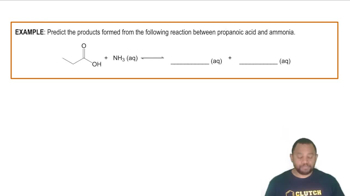
Carboxylic Acid Reactions Example 1

Sodium Hydroxide (NaOH)

Sodium hydroxide, commonly known as lye or caustic soda, is a strong base used in various chemical reactions. When it reacts with acids, it typically undergoes a neutralization reaction, producing water and a salt. In the case of benzoic acid, the reaction with NaOH will yield sodium benzoate and water, illustrating the fundamental acid-base reaction.
Recommended video:
Guided course
01:46
Molarity Example 1

Balanced Chemical Equation

A balanced chemical equation represents a chemical reaction with equal numbers of each type of atom on both sides of the equation. Balancing ensures the law of conservation of mass is upheld, meaning matter is neither created nor destroyed in the reaction. For the reaction between benzoic acid and NaOH, the balanced equation will show the reactants and products in stoichiometric proportions, reflecting the actual quantities involved.
Recommended video:
Guided course
01:32
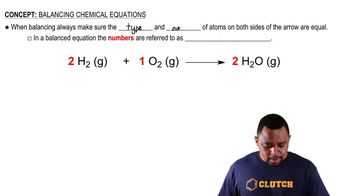
Balancing Chemical Equations (Simplified) Concept 1