Pearson+ LogoPearson+ Logo
Ch.11 Introduction to Organic Chemistry: Hydrocarbons
Timberlake - Chemistry: An Introduction to General, Organic, and Biological Chemistry 13th Edition
Timberlake13th EditionChemistry: An Introduction to General, Organic, and Biological ChemistryISBN: 9780134421353Not the one you use?Change textbook
Chapter 11, Problem 55a

Draw the condensed structural or line-angle formula if cyclic, for each of the following:
a. bromocyclopropane

Verified step by step guidance
1
Step 1: Understand the problem. Bromocyclopropane is a cyclic compound where a bromine atom is attached to a cyclopropane ring. Cyclopropane is a three-membered ring composed of carbon atoms, and bromine is a halogen substituent.
Step 2: Begin by drawing the cyclopropane ring. Cyclopropane is a triangle-shaped structure with three carbon atoms connected by single bonds. Each carbon atom in the ring has two hydrogen atoms attached to it to satisfy the valency of carbon.
Step 3: Identify the position where the bromine atom will be attached. In bromocyclopropane, bromine is bonded to one of the carbon atoms in the cyclopropane ring. Choose any one of the three carbon atoms for the bromine attachment, as the ring is symmetrical.
Step 4: Replace one hydrogen atom on the chosen carbon with a bromine atom. This substitution creates bromocyclopropane, maintaining the cyclic structure while adding the bromine substituent.
Step 5: Represent the structure using the condensed structural formula or line-angle formula. For the condensed structural formula, write the carbon atoms and their attached groups explicitly (e.g., C3H5Br). For the line-angle formula, draw the triangular cyclopropane ring with a line extending to represent the bromine atom.

Verified video answer for a similar problem:

This video solution was recommended by our tutors as helpful for the problem above.
Was this helpful?

Key Concepts

Here are the essential concepts you must grasp in order to answer the question correctly.

Cyclic Compounds

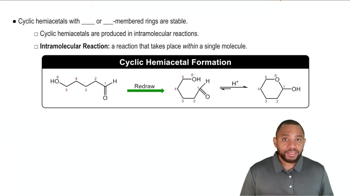
Cyclic compounds are organic molecules that contain a ring structure. They can be saturated or unsaturated and are characterized by the connectivity of their atoms forming a closed loop. Understanding cyclic compounds is essential for drawing their structural formulas, as the arrangement of atoms in a ring affects their chemical properties and reactivity.
Recommended video:
Guided course
2:55
Cyclic Hemiacetals Concept 2

Structural Formulas

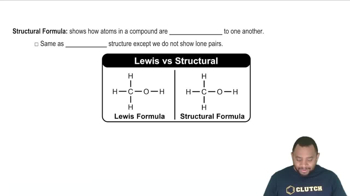
Structural formulas represent the arrangement of atoms within a molecule, showing how they are bonded together. In organic chemistry, condensed structural formulas and line-angle formulas are commonly used to simplify the representation of complex molecules. Mastery of these formulas is crucial for accurately depicting the structure of compounds like bromocyclopropane.
Recommended video:
Guided course
1:01
Structural Formula Concept 2

Bromocyclopropane

Bromocyclopropane is a specific cyclic compound that consists of a three-membered carbon ring (cyclopropane) with a bromine atom attached. Its unique structure influences its chemical behavior, making it important to understand when drawing its structural representation. Recognizing the functional groups and their positions is key to accurately illustrating this compound.