Pearson+ LogoPearson+ Logo
Ch.11 Introduction to Organic Chemistry: Hydrocarbons
Timberlake - Chemistry: An Introduction to General, Organic, and Biological Chemistry 13th Edition
Timberlake13th EditionChemistry: An Introduction to General, Organic, and Biological ChemistryISBN: 9780134421353Not the one you use?Change textbook
Chapter 11, Problem 41a

Match the following physical and chemical properties with potassium chloride, KCl, used in salt substitutes, or butane, C4H10 used in lighters:
<IMAGE>
a. melts at -138°C

Verified step by step guidance
1
Identify the substances involved: potassium chloride (KCl) is an ionic compound, and butane (C₄H₁₀) is a molecular (covalent) compound.
Recall that ionic compounds like KCl generally have high melting points due to strong ionic bonds, while molecular compounds like butane have lower melting points because of weaker intermolecular forces.
Compare the given melting point (-138°C) to typical melting points of ionic and molecular compounds: a melting point this low is characteristic of molecular compounds like butane, not ionic compounds like KCl.
Conclude that the property 'melts at -138°C' corresponds to butane (C₄H₁₀) because it is consistent with the low melting point of molecular substances.
For completeness, remember that KCl would have a much higher melting point, typically above 700°C, due to its ionic lattice structure.

Verified video answer for a similar problem:

This video solution was recommended by our tutors as helpful for the problem above.
Was this helpful?

Key Concepts

Here are the essential concepts you must grasp in order to answer the question correctly.

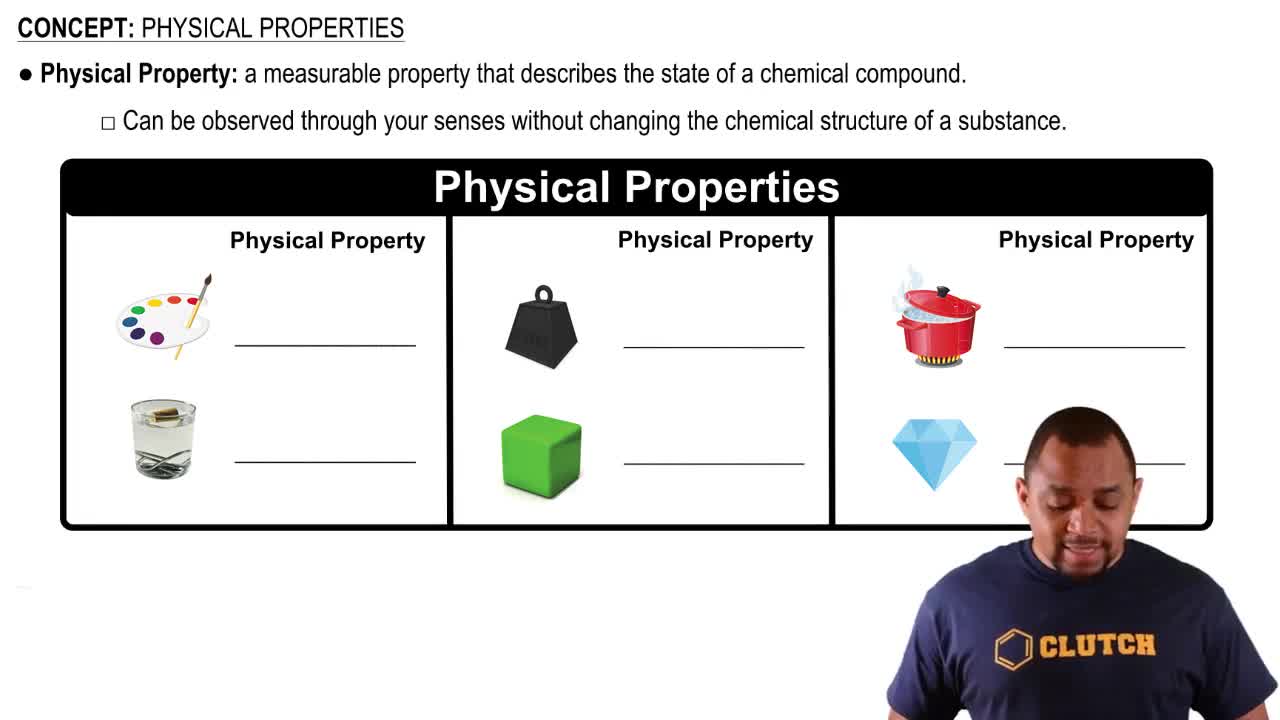
Physical Properties of Substances

Physical properties describe characteristics of a substance that can be observed or measured without changing its chemical identity, such as melting point, boiling point, and state of matter. Understanding these helps differentiate substances like KCl and butane based on their behavior under temperature changes.
Recommended video:
Guided course
02:54
Physical Properties Concept

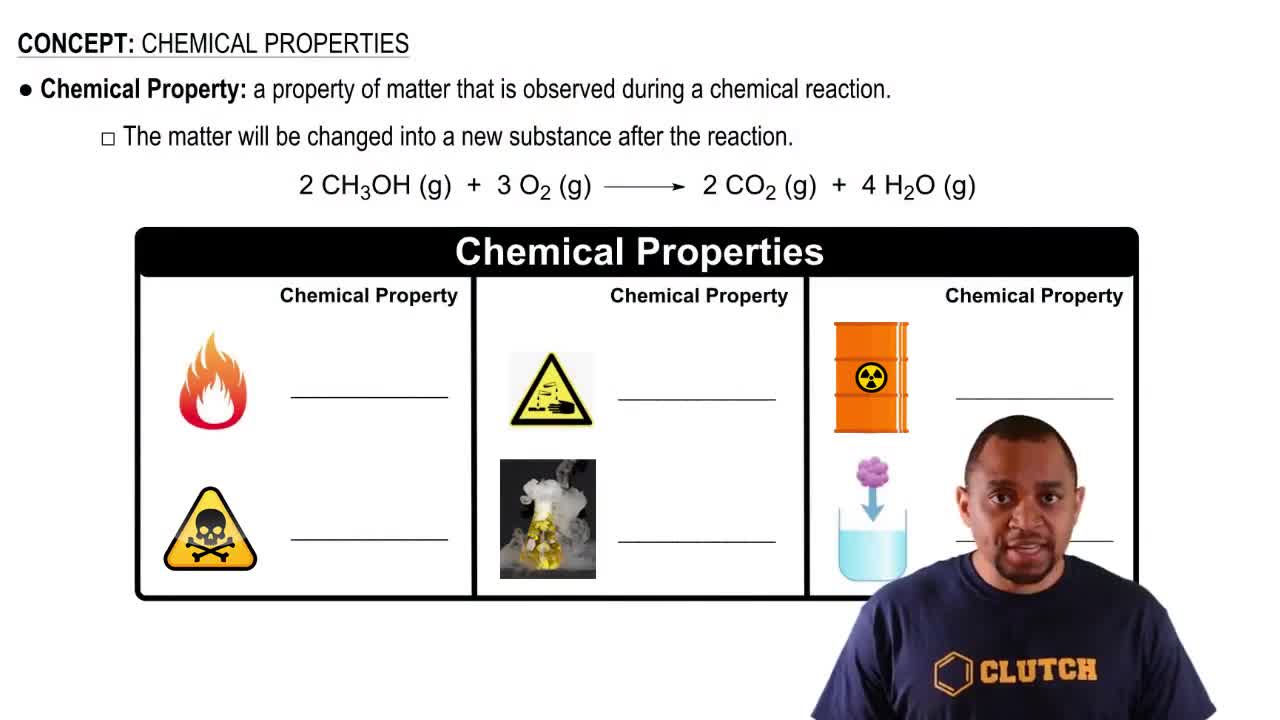
Chemical Properties and Composition

Chemical properties relate to a substance's ability to undergo chemical changes and reactions, determined by its molecular or ionic structure. KCl is an ionic compound with high melting point, while butane is a covalent hydrocarbon with lower melting point, reflecting their distinct chemical nature.
Recommended video:
Guided course
04:22
Chemical Properties Concept

Ionic vs. Covalent Compounds

Ionic compounds like KCl consist of charged ions held by strong electrostatic forces, resulting in high melting points and solid crystalline structures. Covalent compounds like butane have molecules held by weaker intermolecular forces, leading to lower melting points and gaseous or liquid states at room temperature.
Recommended video:
Guided course
02:11
Naming Ionic Compounds