Pearson+ LogoPearson+ Logo
Ch.14 Carboxylic Acids, Esters, Amines, and Amides
Timberlake - Chemistry: An Introduction to General, Organic, and Biological Chemistry 13th Edition
Timberlake13th EditionChemistry: An Introduction to General, Organic, and Biological ChemistryISBN: 9780134421353Not the one you use?Change textbook
Chapter 14, Problem 26

What are the products of the base hydrolysis of an ester?

Verified step by step guidance
1
Understand the concept of base hydrolysis of an ester: Base hydrolysis, also known as saponification, involves the reaction of an ester with a strong base (e.g., NaOH or KOH) to produce a carboxylate salt and an alcohol.
Write the general chemical equation for the reaction: An ester (RCOOR') reacts with a strong base (e.g., NaOH) to form a carboxylate salt (RCOO⁻Na⁺) and an alcohol (R'OH).
Identify the functional groups involved: The ester group (-COOR') is cleaved during the reaction. The carbonyl carbon (C=O) becomes part of the carboxylate salt, while the alkoxy group (-OR') becomes the alcohol.
Explain the mechanism briefly: The hydroxide ion (OH⁻) attacks the carbonyl carbon of the ester, leading to the formation of a tetrahedral intermediate. This intermediate then breaks down, releasing the alcohol and forming the carboxylate salt.
Summarize the products: The products of base hydrolysis of an ester are a carboxylate salt (e.g., RCOO⁻Na⁺) and an alcohol (e.g., R'OH). These products depend on the specific ester and base used in the reaction.

Verified video answer for a similar problem:

This video solution was recommended by our tutors as helpful for the problem above.
Video duration:
2m
Was this helpful?

Key Concepts

Here are the essential concepts you must grasp in order to answer the question correctly.

Ester

An ester is a type of organic compound formed from the reaction between an alcohol and a carboxylic acid, characterized by the functional group -COO-. Esters are commonly used in the production of fragrances, flavorings, and as solvents. Understanding the structure and properties of esters is essential for predicting their behavior in chemical reactions, including hydrolysis.
Recommended video:
Guided course
3:30
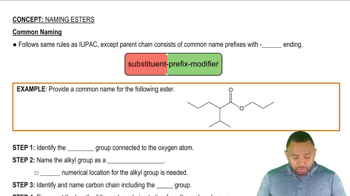
Common Naming: Esters Concept 2

Base Hydrolysis

Base hydrolysis, also known as saponification, is a chemical reaction where an ester reacts with a strong base, typically sodium hydroxide (NaOH), in the presence of water. This process breaks the ester bond, resulting in the formation of an alcohol and a carboxylate salt. Recognizing the conditions and products of base hydrolysis is crucial for understanding how esters can be transformed in chemical processes.
Recommended video:
Guided course
1:07
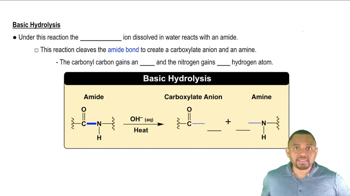
Basic Hydrolysis Concept 2

Products of Hydrolysis

The products of the base hydrolysis of an ester are an alcohol and a carboxylate salt. For example, when ethyl acetate undergoes hydrolysis with sodium hydroxide, it produces ethanol and sodium acetate. Identifying these products is important for applications in organic chemistry, particularly in the synthesis and analysis of various compounds.
Recommended video:
Guided course
0:52
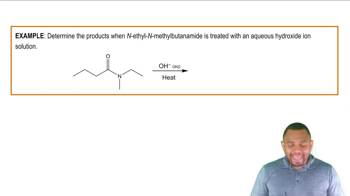
Basic Hydrolysis Example 2