Pearson+ LogoPearson+ Logo
Ch.14 Carboxylic Acids, Esters, Amines, and Amides
Timberlake - Chemistry: An Introduction to General, Organic, and Biological Chemistry 13th Edition
Timberlake13th EditionChemistry: An Introduction to General, Organic, and Biological ChemistryISBN: 9780134421353Not the one you use?Change textbook
Chapter 14, Problem 23c

What is the ester responsible for the flavor and odor of the following fruit?
c. apricot

Verified step by step guidance
1
Step 1: Understand the question. The problem is asking for the ester responsible for the flavor and odor of apricots. Esters are organic compounds formed by the reaction of a carboxylic acid and an alcohol, and they are often responsible for the characteristic smells and flavors of fruits.
Step 2: Recall the common ester associated with apricots. Apricots are known to have a characteristic aroma and flavor due to the presence of a specific ester. This ester is commonly identified as ethyl butanoate or other related esters.
Step 3: Review the structure of ethyl butanoate. Ethyl butanoate is formed by the reaction of butanoic acid (a carboxylic acid) and ethanol (an alcohol). Its chemical formula is C6H12O2, and it has a fruity aroma.
Step 4: Understand the role of esters in fruit flavors. Esters are volatile compounds that easily evaporate, allowing their aroma to be detected by our sense of smell. This is why they are often associated with the characteristic scents of fruits.
Step 5: Conclude that the ester responsible for the flavor and odor of apricots is likely ethyl butanoate, based on its known association with apricot aroma in food chemistry.

Verified video answer for a similar problem:

This video solution was recommended by our tutors as helpful for the problem above.
Video duration:
2m
Was this helpful?

Key Concepts

Here are the essential concepts you must grasp in order to answer the question correctly.

Esters

Esters are organic compounds formed from the reaction of an alcohol and a carboxylic acid. They are known for their distinctive fruity aromas and flavors, making them significant in the food and fragrance industries. In fruits like apricots, specific esters contribute to their characteristic scent and taste, enhancing their appeal.
Recommended video:
Guided course
3:30
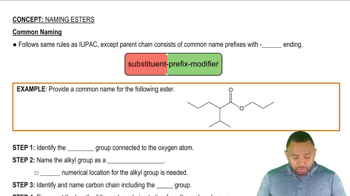
Common Naming: Esters Concept 2

Flavor Compounds

Flavor compounds are chemical substances that contribute to the taste and aroma of food. In fruits, these compounds can include esters, aldehydes, and terpenes, which work together to create the unique sensory experience associated with each fruit. Understanding these compounds helps in identifying the specific ester responsible for a fruit's flavor.
Recommended video:
Guided course
02:11
Naming Ionic Compounds

Apricot Aroma Profile

The aroma profile of apricots is primarily influenced by specific esters, such as ethyl acetate and isoamyl acetate. These compounds are responsible for the sweet, fruity scent that characterizes apricots. Analyzing the aroma profile is essential for identifying the key esters that contribute to the overall flavor and fragrance of the fruit.