Pearson+ LogoPearson+ Logo
Ch.15 Lipids
Timberlake - Chemistry: An Introduction to General, Organic, and Biological Chemistry 13th Edition
Timberlake13th EditionChemistry: An Introduction to General, Organic, and Biological ChemistryISBN: 9780134421353Not the one you use?Change textbook
Chapter 15, Problem 75a

Among the ingredients in lipstick are beeswax, carnauba wax, hydrogenated vegetable oils, and glyceryl tricaprate (tricaprin).
a. What types of lipids are these?

Verified step by step guidance
1
Identify the types of lipids mentioned in the problem: beeswax, carnauba wax, hydrogenated vegetable oils, and glyceryl tricaprate (tricaprin).
Understand the classification of lipids: Lipids are broadly categorized into simple lipids (e.g., waxes), compound lipids (e.g., phospholipids), and derived lipids (e.g., fatty acids, glycerides).
Classify beeswax and carnauba wax as simple lipids because they are esters of fatty acids and long-chain alcohols, which are characteristic of waxes.
Classify hydrogenated vegetable oils as derived lipids because they are chemically modified triglycerides, where unsaturated fatty acids have been converted to saturated ones through hydrogenation.
Classify glyceryl tricaprate (tricaprin) as a triglyceride, which is a type of compound lipid formed by the esterification of glycerol with three fatty acid molecules.

Key Concepts

Here are the essential concepts you must grasp in order to answer the question correctly.

Lipids

Lipids are a diverse group of hydrophobic organic compounds that are insoluble in water but soluble in organic solvents. They play crucial roles in biological systems, including energy storage, structural components of cell membranes, and signaling molecules. Common types of lipids include fats, oils, waxes, and phospholipids.
Recommended video:
Guided course
1:28
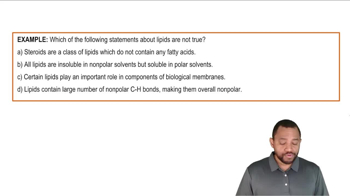
Intro to Lipids Example 1

Waxes

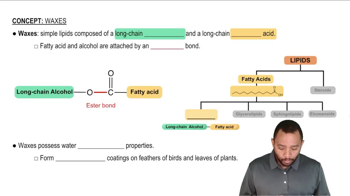
Waxes are a type of lipid characterized by long-chain fatty acids esterified to long-chain alcohols. They are solid at room temperature and provide protective coatings in nature, such as on leaves and fruits. In cosmetics, waxes like beeswax and carnauba wax are used for their emollient properties and to provide structure and stability to products like lipstick.
Recommended video:
Guided course
1:37
Waxes Concept 1

Hydrogenated Oils

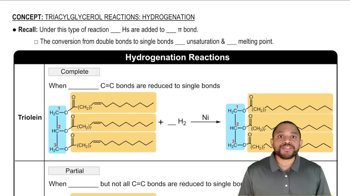
Hydrogenated oils are vegetable oils that have undergone a chemical process to add hydrogen atoms, converting unsaturated fats into saturated fats. This process increases the oil's stability and shelf life, making it suitable for use in various cosmetic formulations. In lipsticks, hydrogenated vegetable oils contribute to texture and moisture retention.
Recommended video:
Guided course
3:01
Triacylglycerol Reactions: Hydrogenation Concept 1