Pearson+ LogoPearson+ Logo
Ch.15 Lipids
Timberlake - Chemistry: An Introduction to General, Organic, and Biological Chemistry 13th Edition
Timberlake13th EditionChemistry: An Introduction to General, Organic, and Biological ChemistryISBN: 9780134421353Not the one you use?Change textbook
Chapter 15, Problem 71

Palm oil has a high level of glyceryl tripalmitate (tripalmitin). Draw the condensed structural formula for glyceryl tripalmitate.
<IMAGE>

Verified step by step guidance
1
Understand the structure of glyceryl tripalmitate (tripalmitin): It is a triglyceride, meaning it consists of a glycerol backbone esterified with three palmitic acid molecules. Palmitic acid is a saturated fatty acid with the formula CH₃(CH₂)₁₄COOH.
Start by drawing the glycerol backbone: Glycerol is a three-carbon molecule with the formula HOCH₂-CHOH-CH₂OH. Each hydroxyl group (-OH) will form an ester bond with a palmitic acid molecule.
Draw the palmitic acid chains: Each palmitic acid chain is represented as CH₃(CH₂)₁₄COO-. This is the fatty acid portion that will attach to the glycerol backbone via ester bonds.
Combine the glycerol and palmitic acid chains: Replace each hydroxyl group (-OH) on the glycerol with an ester group (-OCO-) from the palmitic acid. The resulting structure will have three long hydrocarbon chains attached to the glycerol backbone.
Write the condensed structural formula: The final condensed structural formula for glyceryl tripalmitate will be CH₂(OCO(CH₂)₁₄CH₃)-CH(OCO(CH₂)₁₄CH₃)-CH₂(OCO(CH₂)₁₄CH₃), representing the glycerol backbone and the three palmitic acid chains.

Verified video answer for a similar problem:

This video solution was recommended by our tutors as helpful for the problem above.
Video duration:
2m
Was this helpful?

Key Concepts

Here are the essential concepts you must grasp in order to answer the question correctly.

Glyceryl Tripalmitate Structure

Glyceryl tripalmitate, also known as tripalmitin, is a triglyceride formed from glycerol and three palmitic acid molecules. Its condensed structural formula represents the arrangement of carbon (C), hydrogen (H), and oxygen (O) atoms, highlighting the ester bonds between the glycerol backbone and the fatty acid chains. Understanding its structure is essential for analyzing its properties and applications in food and cosmetics.
Recommended video:
Guided course
1:20
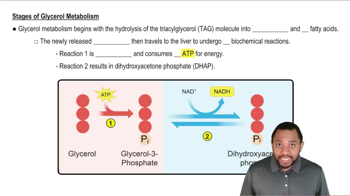
Glycerol Metabolism Concept 2

Condensed Structural Formula

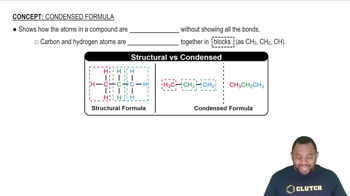
A condensed structural formula is a simplified representation of a chemical compound that shows the arrangement of atoms without depicting all the bonds explicitly. It provides a clear view of how atoms are connected, making it easier to visualize the molecular structure. For glyceryl tripalmitate, this formula will illustrate the three palmitic acid chains attached to the glycerol molecule.
Recommended video:
Guided course
1:53
Condensed Formula Concept 1

Fatty Acids and Triglycerides

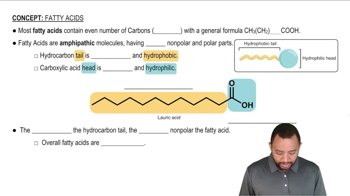
Fatty acids are long hydrocarbon chains with a carboxylic acid group at one end, and they are key components of lipids. Triglycerides, like glyceryl tripalmitate, consist of glycerol bonded to three fatty acids, serving as a major form of energy storage in organisms. Understanding the role of fatty acids in triglycerides is crucial for grasping the biochemical significance of compounds like palm oil.
Recommended video:
Guided course
2:00
Fatty Acids Concept 1