Pearson+ LogoPearson+ Logo
Ch.15 Lipids
Timberlake - Chemistry: An Introduction to General, Organic, and Biological Chemistry 13th Edition
Timberlake13th EditionChemistry: An Introduction to General, Organic, and Biological ChemistryISBN: 9780134421353Not the one you use?Change textbook
Chapter 15, Problem 1

Lipids are not soluble in water. Are lipids polar or nonpolar molecules?

Verified step by step guidance
1
Lipids are generally nonpolar molecules. This means they do not have a significant charge separation within their structure, which is why they are not attracted to polar molecules like water.
Water is a polar molecule, meaning it has a partial positive charge on one side (hydrogen atoms) and a partial negative charge on the other side (oxygen atom). Polar molecules tend to dissolve other polar substances, a principle known as 'like dissolves like.'
Since lipids are nonpolar, they do not interact favorably with water molecules. Instead, they tend to aggregate together, minimizing their contact with water. This is why lipids are hydrophobic (water-fearing).
The nonpolar nature of lipids is due to their long hydrocarbon chains or nonpolar functional groups, which lack the ability to form hydrogen bonds with water molecules.
In summary, lipids are nonpolar molecules, and their lack of solubility in water is a direct result of their nonpolar nature and water's polar nature.

Verified video answer for a similar problem:

This video solution was recommended by our tutors as helpful for the problem above.
Video duration:
1m
Was this helpful?

Key Concepts

Here are the essential concepts you must grasp in order to answer the question correctly.

Polarity of Molecules

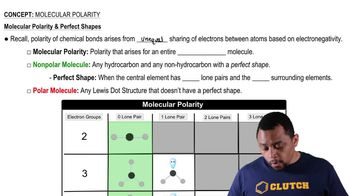
Polarity refers to the distribution of electrical charge around a molecule. Polar molecules have a significant difference in electronegativity between atoms, leading to a partial positive and negative charge, while nonpolar molecules have an even distribution of charge. This property affects how substances interact with each other, particularly in terms of solubility.
Recommended video:
Guided course
01:34
Molecular Polarity (Simplified) Concept 1

Lipids

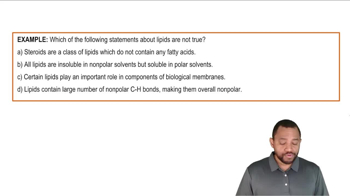
Lipids are a diverse group of hydrophobic organic compounds, including fats, oils, and phospholipids. They are primarily composed of long hydrocarbon chains or rings, which contribute to their nonpolar characteristics. Due to their structure, lipids do not mix well with water, making them essential for forming cell membranes and storing energy.
Recommended video:
Guided course
1:28
Intro to Lipids Example 1

Solubility

Solubility is the ability of a substance to dissolve in a solvent, which is often water for biological systems. The principle of 'like dissolves like' indicates that polar substances tend to dissolve in polar solvents, while nonpolar substances dissolve in nonpolar solvents. Understanding solubility is crucial for predicting how lipids behave in biological environments.
Recommended video:
Guided course
00:28
Solubility Rules