Pearson+ LogoPearson+ Logo
Ch.15 Lipids
Timberlake - Chemistry: An Introduction to General, Organic, and Biological Chemistry 13th Edition
Timberlake13th EditionChemistry: An Introduction to General, Organic, and Biological ChemistryISBN: 9780134421353Not the one you use?Change textbook
Chapter 15, Problem 5

Describe some similarities and differences in the structures of a saturated fatty acid and an unsaturated fatty acid.

Verified step by step guidance
1
A saturated fatty acid has a hydrocarbon chain where all the carbon-carbon bonds are single bonds. This means the chain is fully 'saturated' with hydrogen atoms.
An unsaturated fatty acid contains one or more carbon-carbon double bonds in its hydrocarbon chain. These double bonds reduce the number of hydrogen atoms attached to the carbon chain.
Both saturated and unsaturated fatty acids have a carboxylic acid group (-COOH) at one end of the molecule, which is a common feature of all fatty acids.
The presence of double bonds in unsaturated fatty acids introduces kinks or bends in the hydrocarbon chain, making them less tightly packed compared to the straight chains of saturated fatty acids.
Saturated fatty acids are typically solid at room temperature (e.g., butter), while unsaturated fatty acids are usually liquid at room temperature (e.g., olive oil) due to differences in molecular packing.

Verified video answer for a similar problem:

This video solution was recommended by our tutors as helpful for the problem above.
Video duration:
3m
Was this helpful?

Key Concepts

Here are the essential concepts you must grasp in order to answer the question correctly.

Fatty Acid Structure

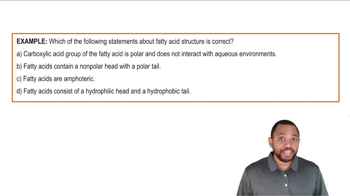
Fatty acids are carboxylic acids with long hydrocarbon chains. They consist of a hydrophilic (water-attracting) carboxyl group (-COOH) at one end and a hydrophobic (water-repelling) hydrocarbon tail. The length and saturation of the hydrocarbon chain influence the physical properties of the fatty acid.
Recommended video:
Guided course
0:55
Fatty Acids Example 1

Saturation

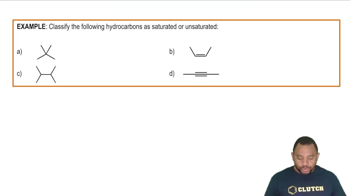
Saturation refers to the presence of double bonds between carbon atoms in the fatty acid chain. Saturated fatty acids have no double bonds, resulting in straight chains that pack tightly together, while unsaturated fatty acids contain one or more double bonds, causing kinks that prevent tight packing and lead to a liquid state at room temperature.
Recommended video:
Guided course
0:57
Saturated and Unsaturated Hydrocarbons Example 2

Physical Properties

The structural differences between saturated and unsaturated fatty acids lead to distinct physical properties. Saturated fatty acids are typically solid at room temperature due to their straight chains, while unsaturated fatty acids are usually liquid, which affects their roles in biological systems and their impact on health.
Recommended video:
Guided course
02:54
Physical Properties Concept