Pearson+ LogoPearson+ Logo
Ch.16 Amino Acids, Proteins, and Enzymes
Timberlake - Chemistry: An Introduction to General, Organic, and Biological Chemistry 13th Edition
Timberlake13th EditionChemistry: An Introduction to General, Organic, and Biological ChemistryISBN: 9780134421353Not the one you use?Change textbook
Chapter 16, Problem 82d

Consider the amino acids histidine, phenylalanine, and serine in an enzyme. State which of these amino acids have R groups that would:
d. form salt bridges

Verified step by step guidance
1
Understand the concept of salt bridges: Salt bridges are ionic interactions that occur between oppositely charged groups in molecules, such as the side chains (R groups) of amino acids. These interactions typically involve a positively charged group (e.g., an amino group) and a negatively charged group (e.g., a carboxylate group).
Examine the R group of histidine: Histidine has an imidazole group in its side chain, which can gain a proton under physiological pH, making it positively charged. This allows histidine to participate in salt bridge formation with negatively charged groups.
Examine the R group of phenylalanine: Phenylalanine has a nonpolar benzyl group in its side chain. Since it is nonpolar and lacks a charge, it cannot form salt bridges.
Examine the R group of serine: Serine has a hydroxymethyl group (-CH2OH) in its side chain. This group is polar but uncharged, so serine cannot form salt bridges.
Conclude which amino acids can form salt bridges: Based on the analysis, histidine is the only amino acid among the three that has an R group capable of forming salt bridges due to its ability to carry a positive charge under physiological conditions.

Verified video answer for a similar problem:

This video solution was recommended by our tutors as helpful for the problem above.
Video duration:
2m
Was this helpful?

Key Concepts

Here are the essential concepts you must grasp in order to answer the question correctly.

Amino Acid R Groups

Amino acids have unique side chains, known as R groups, that determine their properties and interactions. These R groups can be polar, nonpolar, acidic, or basic, influencing how amino acids behave in proteins. Understanding the nature of these R groups is essential for predicting how they will interact with each other and with the environment.
Recommended video:
Guided course
2:21
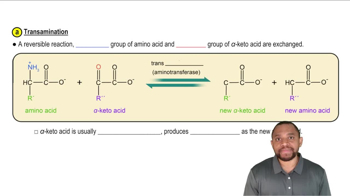
Amino Acid Catabolism: Amino Group Concept 2

Salt Bridges

Salt bridges are non-covalent interactions that occur between positively and negatively charged R groups of amino acids. They play a crucial role in stabilizing protein structures and are particularly important in enzyme function. Identifying which amino acids can form salt bridges helps in understanding the overall stability and activity of the enzyme.
Recommended video:

Enzyme Structure and Function

The structure of an enzyme is intricately linked to its function, with specific amino acids contributing to the active site and overall stability. The arrangement of R groups affects how substrates bind and how the enzyme catalyzes reactions. Recognizing the role of specific amino acids in enzyme activity is vital for comprehending biochemical processes.
Recommended video:
Guided course
02:16
Logarithmic Functions