Pearson+ LogoPearson+ Logo
Ch.16 Amino Acids, Proteins, and Enzymes
Timberlake - Chemistry: An Introduction to General, Organic, and Biological Chemistry 13th Edition
Timberlake13th EditionChemistry: An Introduction to General, Organic, and Biological ChemistryISBN: 9780134421353Not the one you use?Change textbook
Chapter 16, Problem 19

What is the difference in hydrogen bonding between an α helix and a β−pleated sheet?

Verified step by step guidance
1
Understand the concept of hydrogen bonding: Hydrogen bonds are weak interactions between a hydrogen atom covalently bonded to an electronegative atom (like oxygen or nitrogen) and another electronegative atom. These bonds play a crucial role in stabilizing protein secondary structures such as α helices and β-pleated sheets.
Examine the α helix structure: In an α helix, hydrogen bonds form between the carbonyl oxygen (C=O) of one amino acid and the amide hydrogen (N-H) of another amino acid located four residues away in the sequence. These bonds are parallel to the axis of the helix, creating a coiled structure.
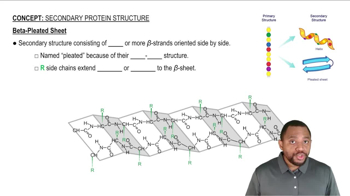
Examine the β-pleated sheet structure: In a β-pleated sheet, hydrogen bonds form between the carbonyl oxygen (C=O) of one amino acid in one strand and the amide hydrogen (N-H) of another amino acid in an adjacent strand. These bonds are perpendicular to the strands, creating a sheet-like structure.
Compare the orientation of hydrogen bonds: In an α helix, the hydrogen bonds are intramolecular (within the same polypeptide chain) and aligned parallel to the helix axis. In a β-pleated sheet, the hydrogen bonds are intermolecular (between different polypeptide chains or regions of the same chain) and aligned perpendicular to the strands.
Summarize the difference: The key difference lies in the arrangement and orientation of hydrogen bonds. In an α helix, the bonds stabilize a coiled structure within a single chain, while in a β-pleated sheet, the bonds stabilize a sheet-like structure between adjacent chains or regions.

Verified video answer for a similar problem:

This video solution was recommended by our tutors as helpful for the problem above.
Video duration:
1m
Was this helpful?

Key Concepts

Here are the essential concepts you must grasp in order to answer the question correctly.

Hydrogen Bonding

Hydrogen bonding is a type of attractive interaction that occurs between a hydrogen atom covalently bonded to an electronegative atom and another electronegative atom. In proteins, hydrogen bonds play a crucial role in stabilizing secondary structures like α helices and β-pleated sheets. These bonds are relatively weak compared to covalent bonds but are significant in maintaining the overall structure of proteins.
Recommended video:
Guided course
1:22
Hydrogenation Reactions Concept 1

α Helix

The α helix is a common structural motif in proteins characterized by a right-handed coil where each turn of the helix contains about 3.6 amino acids. In an α helix, hydrogen bonds form between the carbonyl oxygen of one amino acid and the amide hydrogen of another amino acid four residues down the chain. This pattern of bonding contributes to the stability and rigidity of the helical structure.
Recommended video:
Guided course
3:27
DNA Double Helix Concept 1

β-Pleated Sheet

The β-pleated sheet is another fundamental secondary structure in proteins, consisting of strands of amino acids that are linked together by hydrogen bonds, forming a sheet-like arrangement. In this structure, hydrogen bonds can occur between carbonyl oxygens and amide hydrogens of adjacent strands, which can run parallel or antiparallel to each other. This arrangement provides a different type of stability and is crucial for the overall folding and function of many proteins.
Recommended video:
Guided course
2:42
Beta-Pleated Sheet Concept 4