Pearson+ LogoPearson+ Logo
Ch.16 Amino Acids, Proteins, and Enzymes
Timberlake - Chemistry: An Introduction to General, Organic, and Biological Chemistry 13th Edition
Timberlake13th EditionChemistry: An Introduction to General, Organic, and Biological ChemistryISBN: 9780134421353Not the one you use?Change textbook
Chapter 16, Problem 29

Why do chemical reactions in the body require enzymes?

Verified step by step guidance
1
Chemical reactions in the body often occur at rates that are too slow to sustain life processes under normal physiological conditions. Enzymes act as biological catalysts to speed up these reactions.
Enzymes lower the activation energy of a chemical reaction, which is the minimum energy required for the reactants to transform into products. This allows reactions to occur more efficiently and at a faster rate.
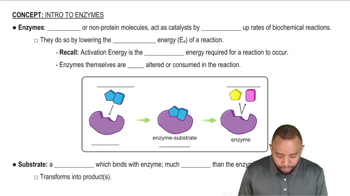
Enzymes are highly specific to the reactions they catalyze. They bind to specific substrates (reactants) at their active site, forming an enzyme-substrate complex, which facilitates the conversion of substrates into products.
Enzymes ensure that reactions occur under mild conditions, such as normal body temperature and pH, which are essential for maintaining homeostasis in the body.
Without enzymes, many biochemical reactions would either not occur or would proceed too slowly to support essential functions like energy production, digestion, and cellular repair.

Verified video answer for a similar problem:

This video solution was recommended by our tutors as helpful for the problem above.
Video duration:
4m
Was this helpful?

Key Concepts

Here are the essential concepts you must grasp in order to answer the question correctly.

Enzymes

Enzymes are biological catalysts that speed up chemical reactions in the body by lowering the activation energy required for the reaction to occur. They are typically proteins that bind to substrates, facilitating their conversion into products. Without enzymes, many biochemical reactions would occur too slowly to sustain life.
Recommended video:
Guided course
2:14
Intro to Enzymes Concept 1

Activation Energy

Activation energy is the minimum energy required for a chemical reaction to take place. Enzymes reduce this energy barrier, allowing reactions to proceed at a faster rate and under milder conditions than would otherwise be possible. This is crucial in biological systems where temperature and pressure are tightly regulated.
Recommended video:
Guided course
1:06
Factors Affecting Enzyme Activity Concept 1

Metabolism

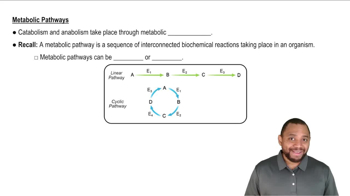
Metabolism encompasses all the chemical reactions that occur within a living organism to maintain life, including those that break down nutrients for energy and those that synthesize necessary compounds. Enzymes play a vital role in metabolic pathways, ensuring that these reactions are efficient and properly regulated to meet the organism's needs.
Recommended video:
Guided course
0:52
Metabolic Pathways Concept 2