Pearson+ LogoPearson+ Logo
Ch.16 Amino Acids, Proteins, and Enzymes
Timberlake - Chemistry: An Introduction to General, Organic, and Biological Chemistry 13th Edition
Timberlake13th EditionChemistry: An Introduction to General, Organic, and Biological ChemistryISBN: 9780134421353Not the one you use?Change textbook
Chapter 16, Problem 33c

What is the name of the class of enzymes that would catalyze each of the following reactions?
c. converting glucose (C6H12O6) to fructose (C6H12O6).

Verified step by step guidance
1
Understand the reaction: The conversion of glucose (C₆H₁₂O₆) to fructose (C₆H₁₂O₆) involves the rearrangement of atoms within the molecule, changing its structure but not its molecular formula. This type of reaction is known as an isomerization reaction.
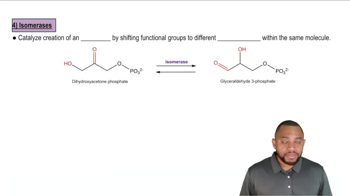
Identify the enzyme class: Enzymes that catalyze isomerization reactions are called isomerases. These enzymes facilitate the rearrangement of atoms within a molecule to form an isomer.
Relate the enzyme class to the specific reaction: In this case, the enzyme responsible for converting glucose to fructose would belong to the isomerase class, as it is facilitating the structural rearrangement of the molecule.
Consider the specific enzyme: For the conversion of glucose to fructose, the specific enzyme involved is glucose isomerase (also known as phosphoglucose isomerase in some pathways). This enzyme is commonly used in biological systems and industrial applications.
Summarize the concept: The class of enzyme that catalyzes the conversion of glucose to fructose is isomerase, specifically glucose isomerase, which facilitates the structural rearrangement of the molecule without altering its molecular formula.

Verified video answer for a similar problem:

This video solution was recommended by our tutors as helpful for the problem above.
Video duration:
1m
Was this helpful?

Key Concepts

Here are the essential concepts you must grasp in order to answer the question correctly.

Enzymes

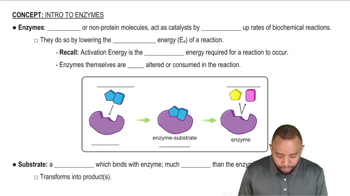
Enzymes are biological catalysts that accelerate chemical reactions in living organisms. They are typically proteins that lower the activation energy required for reactions, allowing them to occur more quickly and efficiently. Each enzyme is specific to a particular reaction or type of reaction, which is determined by its unique structure.
Recommended video:
Guided course
2:14
Intro to Enzymes Concept 1

Isomerization

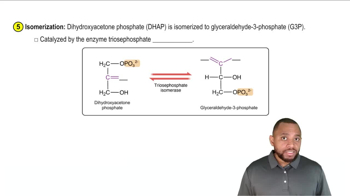
Isomerization is a type of chemical reaction in which a molecule is transformed into another molecule with the same atoms but in a different arrangement. In the context of glucose and fructose, this process involves the rearrangement of the molecular structure of glucose to form fructose, both of which are isomers of each other.
Recommended video:
Guided course
1:26
Glycolysis Concept 5

Hexose Isomerase

Hexose isomerase is a specific class of enzymes that catalyze the isomerization of hexose sugars, such as glucose and fructose. This enzyme facilitates the conversion of glucose to fructose by rearranging the carbon atoms in the sugar molecule. Understanding the role of hexose isomerase is crucial for studying carbohydrate metabolism and energy production in cells.
Recommended video:
Guided course
1:06
Isomerases Concept 7