Pearson+ LogoPearson+ Logo
Ch.17 Nucleic Acids and Protein Synthesis
Timberlake - Chemistry: An Introduction to General, Organic, and Biological Chemistry 13th Edition
Timberlake13th EditionChemistry: An Introduction to General, Organic, and Biological ChemistryISBN: 9780134421353Not the one you use?Change textbook
Chapter 17, Problem 93a

Identify the base and sugar in each of the following nucleosides:
a. deoxythymidine

Verified step by step guidance
1
Understand the structure of a nucleoside: A nucleoside consists of a nitrogenous base attached to a sugar molecule. The sugar can be either ribose (in RNA) or deoxyribose (in DNA).
Identify the sugar in deoxythymidine: The prefix 'deoxy-' indicates that the sugar is deoxyribose, which is a modified form of ribose lacking an oxygen atom at the 2' position.
Identify the base in deoxythymidine: The name 'thymidine' refers to the nitrogenous base thymine, which is a pyrimidine base commonly found in DNA.
Combine the base and sugar: Deoxythymidine is composed of the thymine base attached to the deoxyribose sugar via a glycosidic bond.
Verify the context: Ensure that the nucleoside is part of DNA, as indicated by the presence of deoxyribose and thymine, which are specific to DNA.

Verified video answer for a similar problem:

This video solution was recommended by our tutors as helpful for the problem above.
Video duration:
46s
Was this helpful?

Key Concepts

Here are the essential concepts you must grasp in order to answer the question correctly.

Nucleosides

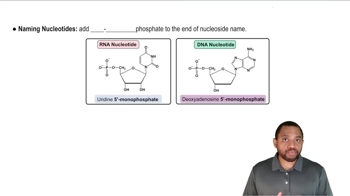
Nucleosides are organic molecules that consist of a nitrogenous base attached to a sugar molecule. They are the building blocks of nucleotides, which are essential for forming DNA and RNA. In nucleosides, the sugar can be either ribose (in RNA) or deoxyribose (in DNA), and the nitrogenous base can be adenine, guanine, cytosine, or thymine.
Recommended video:
Guided course
1:21
Naming Nucleosides and Nucleotides Concept 2

Deoxythymidine

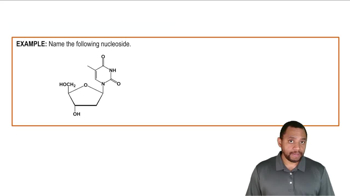
Deoxythymidine is a specific nucleoside that consists of the nitrogenous base thymine attached to a deoxyribose sugar. It is a component of DNA, where it pairs with adenine during DNA replication. Understanding its structure is crucial for identifying the base and sugar in nucleosides.
Recommended video:
Guided course
1:53
Naming Nucleosides and Nucleotides Example

Nitrogenous Bases

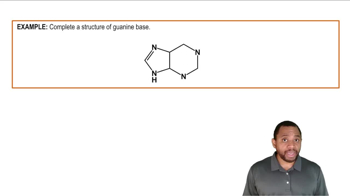
Nitrogenous bases are the fundamental components of nucleotides and nucleosides, categorized into purines (adenine and guanine) and pyrimidines (cytosine and thymine). These bases are responsible for the genetic coding in DNA and RNA, as they form specific pairs (A-T and C-G in DNA) that dictate the sequence of genetic information.
Recommended video:
Guided course
1:23
Nitrogenous Bases Example 3