Pearson+ LogoPearson+ Logo
Ch.18 Metabolic Pathways and ATP Production
Timberlake - Chemistry: An Introduction to General, Organic, and Biological Chemistry 13th Edition
Timberlake13th EditionChemistry: An Introduction to General, Organic, and Biological ChemistryISBN: 9780134421353Not the one you use?Change textbook
Chapter 18, Problem 59a

Consider the complete oxidation of oleic acid, CH3 ― (CH2)7 ― CH = CH ― (CH2)7 ― COOH, which is a C18 monounsaturated fatty acid.
a. How many cycles of β oxidation are needed?

Verified step by step guidance
1
Step 1: Understand the structure of oleic acid. It is a C₁₈ monounsaturated fatty acid, meaning it has 18 carbon atoms and one double bond in its hydrocarbon chain.
Step 2: Recall the process of β oxidation. Each cycle of β oxidation removes a two-carbon unit (acetyl-CoA) from the fatty acid chain. The number of cycles required depends on the total number of carbon atoms in the fatty acid.
Step 3: Determine the number of acetyl-CoA units produced. For a fatty acid with 18 carbons, β oxidation will produce 9 acetyl-CoA molecules, as each acetyl-CoA contains 2 carbons.
Step 4: Account for the double bond in oleic acid. The presence of a double bond requires an additional enzymatic step during β oxidation, but it does not change the number of cycles needed to completely oxidize the fatty acid.
Step 5: Calculate the number of β oxidation cycles. Since the final cycle produces two acetyl-CoA molecules, the total number of cycles required is one less than the number of acetyl-CoA molecules produced. For oleic acid, this means 8 cycles of β oxidation are needed.

Verified video answer for a similar problem:

This video solution was recommended by our tutors as helpful for the problem above.
Video duration:
1m
Was this helpful?

Key Concepts

Here are the essential concepts you must grasp in order to answer the question correctly.

β-Oxidation

β-Oxidation is a metabolic process that breaks down fatty acids into acetyl-CoA units, which can then enter the citric acid cycle for energy production. Each cycle of β-oxidation removes two carbon atoms from the fatty acid chain, producing one acetyl-CoA and one FADH2 and NADH, which are used in the electron transport chain.

Fatty Acid Structure

Fatty acids are carboxylic acids with long hydrocarbon chains. Oleic acid, a monounsaturated fatty acid, has 18 carbon atoms and one double bond. The presence of a double bond affects the number of β-oxidation cycles, as it alters the way the fatty acid is processed during oxidation.
Recommended video:
Guided course
0:55
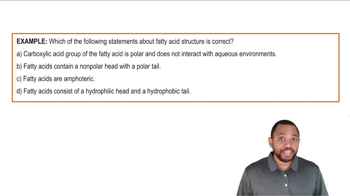
Fatty Acids Example 1

Cycle Calculation

To determine the number of β-oxidation cycles needed for a fatty acid, the formula is (n/2) - 1, where n is the number of carbon atoms. For oleic acid (C₁₈), this means (18/2) - 1 = 8 cycles, as each cycle shortens the fatty acid chain by two carbons until it is fully oxidized.
Recommended video:
Guided course
0:51
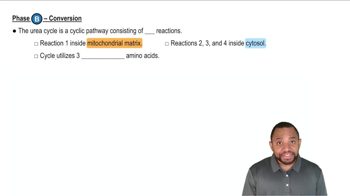
The Urea Cycle Concept 3