Pearson+ LogoPearson+ Logo
Ch.18 Metabolic Pathways and ATP Production
Timberlake - Chemistry: An Introduction to General, Organic, and Biological Chemistry 13th Edition
Timberlake13th EditionChemistry: An Introduction to General, Organic, and Biological ChemistryISBN: 9780134421353Not the one you use?Change textbook
Chapter 18, Problem 83

When is pyruvate converted to lactate in the body?

Verified step by step guidance
1
Understand the context: Pyruvate is a key intermediate in cellular metabolism, specifically in glycolysis, where glucose is broken down to produce energy in the form of ATP.
Recognize the conditions: Pyruvate is converted to lactate in the body under anaerobic conditions, meaning when oxygen levels are insufficient to support aerobic respiration.
Identify the process: In anaerobic conditions, cells rely on a process called lactic acid fermentation to regenerate NAD⁺ from NADH. This is crucial because NAD⁺ is required for glycolysis to continue producing ATP.
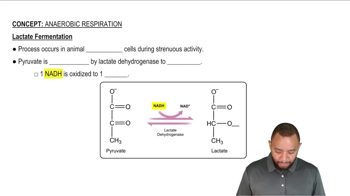
Describe the reaction: During lactic acid fermentation, the enzyme lactate dehydrogenase catalyzes the reduction of pyruvate to lactate, using NADH as a reducing agent and regenerating NAD⁺ in the process.
Relate to physiological scenarios: This conversion typically occurs in muscle cells during intense exercise when oxygen supply cannot meet the demand, leading to the accumulation of lactate and the sensation of muscle fatigue.

Verified video answer for a similar problem:

This video solution was recommended by our tutors as helpful for the problem above.
Video duration:
2m
Was this helpful?

Key Concepts

Here are the essential concepts you must grasp in order to answer the question correctly.

Pyruvate Metabolism

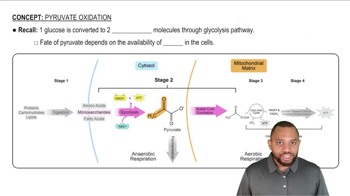
Pyruvate is a key intermediate in cellular metabolism, primarily produced during glycolysis. It can be further metabolized in the presence of oxygen through the citric acid cycle or converted to lactate in anaerobic conditions. Understanding the conditions under which pyruvate is converted to lactate is crucial for grasping energy production in cells.
Recommended video:
Guided course
1:49
Pyruvate Oxidation Concept 1

Lactate Fermentation

Lactate fermentation is an anaerobic process where pyruvate is reduced to lactate by the enzyme lactate dehydrogenase. This process occurs when oxygen levels are low, such as during intense exercise, allowing for continued ATP production despite the lack of aerobic respiration. It is essential for understanding how muscles cope with energy demands under low oxygen conditions.
Recommended video:
Guided course
1:14
Anaerobic Respiration Concept 3

Oxygen Debt

Oxygen debt refers to the amount of oxygen required to restore the body to its resting state after exercise. During intense physical activity, the body may rely on anaerobic metabolism, leading to lactate accumulation. Recognizing the concept of oxygen debt helps explain why lactate is produced and how the body recovers post-exercise.
Recommended video:
Guided course
01:32
Balancing Chemical Equations (Simplified) Concept 1