Identify each of the following as a six-carbon or a three-carbon compound and arrange them in the order in which they occur in glycolysis: a. 3-phosphoglycerate
Verified step by step guidance
1
Understand the context of glycolysis: Glycolysis is a metabolic pathway that breaks down glucose (a six-carbon molecule) into two molecules of pyruvate (each a three-carbon molecule). Along the way, intermediates are formed, which can be either six-carbon or three-carbon compounds.
Identify the compound given in the problem: The compound mentioned is 3-phosphoglycerate. This is a three-carbon compound because it is derived from the splitting of the six-carbon molecule fructose-1,6-bisphosphate earlier in glycolysis.
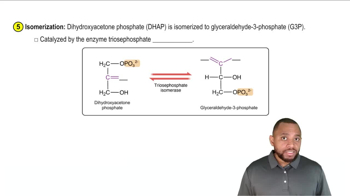
Recall the sequence of glycolysis: Glycolysis begins with glucose (six-carbon), progresses through intermediates like fructose-1,6-bisphosphate (six-carbon), and then splits into two three-carbon molecules, which are further processed into compounds like 3-phosphoglycerate.
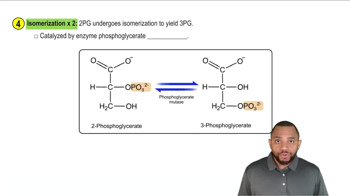
Determine the position of 3-phosphoglycerate in glycolysis: 3-phosphoglycerate is formed after the conversion of 1,3-bisphosphoglycerate (a three-carbon compound) during the energy payoff phase of glycolysis.
Arrange the compounds in order: If other compounds are provided in the problem, arrange them based on their occurrence in glycolysis, starting with six-carbon compounds (like glucose) and progressing to three-carbon compounds (like 3-phosphoglycerate).
Verified video answer for a similar problem:
This video solution was recommended by our tutors as helpful for the problem above
Video duration:
5m
Play a video:
Was this helpful?
Key Concepts
Here are the essential concepts you must grasp in order to answer the question correctly.
Glycolysis
Glycolysis is a metabolic pathway that converts glucose into pyruvate, producing energy in the form of ATP. It occurs in the cytoplasm of cells and consists of ten enzyme-catalyzed reactions. Understanding glycolysis is essential for identifying the compounds involved and their respective roles in energy production.
Carbon compounds are organic molecules that contain carbon atoms, which can be classified based on the number of carbon atoms they possess. In glycolysis, compounds can be categorized as three-carbon (like glyceraldehyde-3-phosphate) or six-carbon (like glucose). This classification is crucial for understanding the progression of the glycolytic pathway.
3-Phosphoglycerate (3-PG) is a three-carbon compound that plays a key role in glycolysis and the Calvin cycle. It is formed from the conversion of 1,3-bisphosphoglycerate and is an important intermediate in the glycolytic pathway. Recognizing its structure and function helps in arranging the compounds in the correct order during glycolysis.