
Pearson+ LogoPearson+ Logo
Ch.2 Chemistry and Measurements
Timberlake - Chemistry: An Introduction to General, Organic, and Biological Chemistry 13th Edition
Timberlake13th EditionChemistry: An Introduction to General, Organic, and Biological ChemistryISBN: 9780134421353Not the one you use?Change textbook
Chapter 2, Problem 7c

On a typical day, medical personnel may encounter several situations involving measurement. State the name and type of measurement indicated by the units in each of the following:
c. An antacid tablet contains 1.0 g of calcium carbonate.

Verified step by step guidance
1
Identify the unit provided in the problem: The unit given is 'g,' which stands for grams.
Determine the type of measurement associated with the unit 'grams': Grams are a unit of mass, which is used to measure the amount of matter in an object.
Recognize the substance being measured: The problem specifies calcium carbonate, which is a chemical compound commonly found in antacid tablets.
State the name of the measurement: The name of the measurement is 'mass,' as it quantifies the amount of calcium carbonate in the tablet.
Conclude that the type of measurement indicated by the unit 'grams' is mass, and the name of the measurement is mass of calcium carbonate.

Verified video answer for a similar problem:

This video solution was recommended by our tutors as helpful for the problem above.
Video duration:
1m
Was this helpful?

Key Concepts

Here are the essential concepts you must grasp in order to answer the question correctly.

Mass Measurement

Mass measurement refers to the quantification of the amount of matter in an object, typically expressed in grams (g) or kilograms (kg). In the context of the antacid tablet, the measurement of 1.0 g indicates the mass of calcium carbonate present, which is crucial for understanding dosage and efficacy in medical applications.
Recommended video:
Guided course
02:52
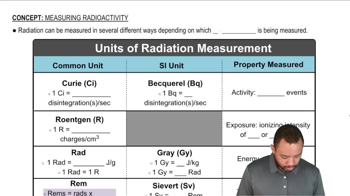
Measuring Radioactivity Concept 1

Calcium Carbonate

Calcium carbonate is a chemical compound with the formula CaCO3, commonly used in antacids to neutralize stomach acid. Understanding its role and properties is essential for evaluating its effectiveness in treating conditions like heartburn or indigestion, as well as its dosage in relation to the mass measurement provided.
Recommended video:
Guided course
5:36
Amino Acid Catabolism: Carbon Atoms Concept 2

Pharmaceutical Dosage

Pharmaceutical dosage refers to the specific amount of a medication or compound that is administered to achieve the desired therapeutic effect. In this case, knowing that an antacid tablet contains 1.0 g of calcium carbonate helps healthcare professionals determine the appropriate dosage for patients, ensuring safety and effectiveness in treatment.