Pearson+ LogoPearson+ Logo
Ch.3 Matter and Energy
Timberlake - Chemistry: An Introduction to General, Organic, and Biological Chemistry 13th Edition
Timberlake13th EditionChemistry: An Introduction to General, Organic, and Biological ChemistryISBN: 9780134421353Not the one you use?Change textbook
Chapter 3, Problem 106a

A metal is thought to be copper or gold. When 18 g of the metal absorbs 58 cal, its temperature rises by 35 °C.
a. What is the specific heat, in cal/g °C, of the metal?

Verified step by step guidance
1
Step 1: Recall the formula for specific heat capacity: q = m c T, where q is the heat absorbed (in calories), m is the mass of the substance (in grams), c is the specific heat capacity (in cal/g °C), and T is the change in temperature (in °C).
Step 2: Rearrange the formula to solve for the specific heat capacity c: c = qm T.
Step 3: Identify the given values from the problem: q = 58 cal, m = 18 g, and T = 35 °C.
Step 4: Substitute the given values into the rearranged formula: c = 5818 35.
Step 5: Simplify the expression to calculate the specific heat capacity c. Ensure the units are consistent and the result is expressed in cal/g °C.

Verified video answer for a similar problem:

This video solution was recommended by our tutors as helpful for the problem above.
Video duration:
1m
Was this helpful?

Key Concepts

Here are the essential concepts you must grasp in order to answer the question correctly.

Specific Heat Capacity

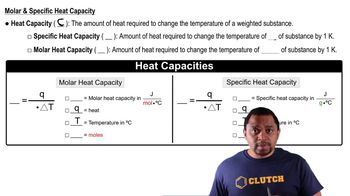
Specific heat capacity is the amount of heat required to raise the temperature of one gram of a substance by one degree Celsius. It is a material-specific property that indicates how much energy a substance can store. The formula to calculate specific heat is given by Q = mcΔT, where Q is the heat absorbed, m is the mass, c is the specific heat, and ΔT is the change in temperature.
Recommended video:
Guided course
02:19
Heat Capacity

Heat Transfer

Heat transfer refers to the movement of thermal energy from one object or substance to another due to a temperature difference. In this context, the metal absorbs heat, which causes its temperature to rise. Understanding how heat is transferred is crucial for calculating specific heat, as it directly relates to the energy absorbed by the substance.
Recommended video:
Guided course
02:19
Heat Capacity

Units of Measurement

In this problem, specific heat is measured in calories per gram per degree Celsius (cal/g °C). It is important to be familiar with these units to correctly interpret the results and perform calculations. The mass of the metal is given in grams, and the heat absorbed is in calories, which aligns with the units used for specific heat, ensuring consistency in the calculations.
Recommended video:
Guided course
02:52
Measuring Radioactivity Concept 1