Pearson+ LogoPearson+ Logo
Ch.3 Matter and Energy
Timberlake - Chemistry: An Introduction to General, Organic, and Biological Chemistry 13th Edition
Timberlake13th EditionChemistry: An Introduction to General, Organic, and Biological ChemistryISBN: 9780134421353Not the one you use?Change textbook
Chapter 3, Problem 100b

When 1.0 g of gasoline burns, it releases 11 kcal. The density of gasoline is 0.74 g/mL.
b. If a television requires 150 kJ/h to run, how many hours can the television run on the energy provided by 1.0 gal of gasoline?

Verified step by step guidance
1
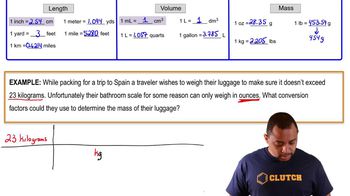
Convert the volume of gasoline from gallons to milliliters. Use the conversion factor: 1 gallon = 3785 mL.
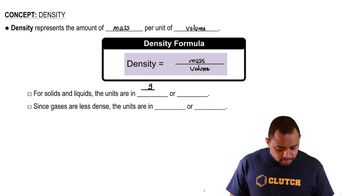
Calculate the mass of gasoline in grams using the density formula: \( \text{Density} = \frac{\text{Mass}}{\text{Volume}} \). Rearrange to find \( \text{Mass} = \text{Density} \times \text{Volume} \). Substitute the density of gasoline (0.74 g/mL) and the volume in mL.
Determine the total energy released by burning the calculated mass of gasoline. Use the given energy release rate: 1.0 g of gasoline releases 11 kcal. Multiply the mass of gasoline by 11 kcal/g to find the total energy in kcal.
Convert the total energy from kcal to kJ. Use the conversion factor: 1 kcal = 4.184 kJ.
Calculate the number of hours the television can run. Divide the total energy in kJ by the energy consumption rate of the television (150 kJ/h).

Verified video answer for a similar problem:

This video solution was recommended by our tutors as helpful for the problem above.
Video duration:
3m
Was this helpful?

Key Concepts

Here are the essential concepts you must grasp in order to answer the question correctly.

Energy Conversion

Energy conversion refers to the process of changing energy from one form to another. In this context, the energy released from burning gasoline (measured in kilocalories) must be converted to kilojoules, as the television's energy requirement is given in kJ. Understanding this conversion is essential for calculating how long the television can run on the energy provided by gasoline.
Recommended video:
Guided course
03:45
Conversion Factors (Simplified) Example 2

Density and Volume Calculations

Density is the mass per unit volume of a substance, and it is crucial for determining how much gasoline is available in a given volume. Given the density of gasoline (0.74 g/mL), one can calculate the total mass of gasoline in 1.0 gallon (which is approximately 3785 mL). This mass is necessary to find the total energy available from the gasoline for the television.
Recommended video:

Power Consumption

Power consumption refers to the rate at which energy is used, typically measured in watts or kilojoules per hour. In this scenario, the television's requirement of 150 kJ/h indicates how much energy it consumes over time. By comparing the total energy available from the gasoline to the power consumption of the television, one can determine the duration for which the television can operate.
Recommended video:
Guided course
04:42
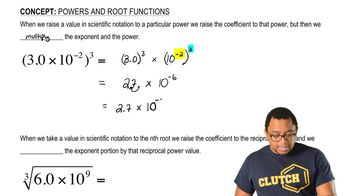
Powers and Root Functions