Pearson+ LogoPearson+ Logo
Ch.3 Matter and Energy
Timberlake - Chemistry: An Introduction to General, Organic, and Biological Chemistry 13th Edition
Timberlake13th EditionChemistry: An Introduction to General, Organic, and Biological ChemistryISBN: 9780134421353Not the one you use?Change textbook
Chapter 3, Problem 44a

Identify each of the following changes of state as melting, freezing, sublimation, or deposition:
a. Dry ice in an ice-cream cart disappears.

Verified step by step guidance
1
Step 1: Understand the process of sublimation. Sublimation is the change of state where a substance transitions directly from a solid to a gas without passing through the liquid phase.
Step 2: Recognize the properties of dry ice. Dry ice is solid carbon dioxide (CO₂), which sublimates at standard atmospheric pressure, meaning it transitions directly from a solid to a gas.
Step 3: Analyze the scenario. The problem states that dry ice 'disappears' in the ice-cream cart. This indicates that the solid dry ice is converting into a gas, as it does not leave behind any liquid residue.
Step 4: Match the observed change of state to the correct term. Since the solid is directly converting to a gas, this process is identified as sublimation.
Step 5: Conclude that the change of state described in the problem is sublimation, based on the properties of dry ice and the definition of sublimation.

Verified video answer for a similar problem:

This video solution was recommended by our tutors as helpful for the problem above.
Video duration:
1m
Was this helpful?

Key Concepts

Here are the essential concepts you must grasp in order to answer the question correctly.

Sublimation

Sublimation is the process where a solid transitions directly into a gas without passing through the liquid state. This occurs when the molecules in the solid gain enough energy to overcome intermolecular forces, allowing them to escape into the air as gas. A common example is dry ice (solid carbon dioxide), which sublimates at room temperature, making it ideal for creating fog effects.
Recommended video:
Guided course
01:23
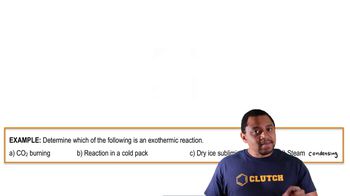
Endothermic & Exothermic Reactions Example 2

Phase Changes

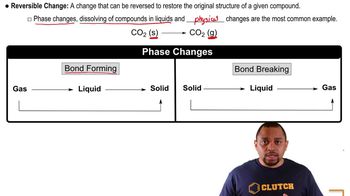
Phase changes refer to the transformations between different states of matter: solid, liquid, and gas. These changes occur due to variations in temperature and pressure, affecting the energy and arrangement of particles. Understanding these transitions is crucial for identifying processes like melting, freezing, sublimation, and deposition, which describe how substances change from one state to another.
Recommended video:
Guided course
03:40
Physical & Chemical Changes

Dry Ice

Dry ice is the solid form of carbon dioxide (CO2) and is commonly used as a refrigerant. It sublimates at -78.5 degrees Celsius, meaning it changes directly from solid to gas without becoming liquid. This property makes dry ice useful in various applications, including food preservation and theatrical effects, as seen in the example of it disappearing in an ice-cream cart.
Recommended video:
Guided course
01:23
Endothermic & Exothermic Reactions Example 2