Pearson+ LogoPearson+ Logo
Ch.3 Matter and Energy
Timberlake - Chemistry: An Introduction to General, Organic, and Biological Chemistry 13th Edition
Timberlake13th EditionChemistry: An Introduction to General, Organic, and Biological ChemistryISBN: 9780134421353Not the one you use?Change textbook
Chapter 3, Problem 41c

Use the heat equation to calculate the energy, in joules and calories, for each of the following (see TABLE 3.11):
c. lost when 15.0 g of ethanol, C2H6O, cools from 60.5 °C to −42.0 °C

Verified step by step guidance
1
Step 1: Identify the heat equation to use: \( q = m \cdot c \cdot \Delta T \), where \( q \) is the heat energy, \( m \) is the mass, \( c \) is the specific heat capacity, and \( \Delta T \) is the change in temperature.
Step 2: Determine the values given in the problem: \( m = 15.0 \; \text{g} \), \( \Delta T = T_{\text{final}} - T_{\text{initial}} = -42.0 \; ^\circ\text{C} - 60.5 \; ^\circ\text{C} \), and the specific heat capacity of ethanol (not methanol) must be obtained from a reliable source, as the table provided does not include ethanol.
Step 3: Calculate \( \Delta T \): Subtract the final temperature from the initial temperature to find the temperature change. Ensure the sign is correct, as cooling results in a negative \( \Delta T \).
Step 4: Substitute the values into the heat equation for both joules and calories. Use the specific heat capacity in \( \text{J/g} \cdot ^\circ\text{C} \) for joules and \( \text{cal/g} \cdot ^\circ\text{C} \) for calories.
Step 5: Perform the calculations separately for joules and calories to find the energy lost. Ensure unit consistency throughout the calculation.

Verified video answer for a similar problem:

This video solution was recommended by our tutors as helpful for the problem above.
Video duration:
6m
Was this helpful?

Key Concepts

Here are the essential concepts you must grasp in order to answer the question correctly.

Heat Equation

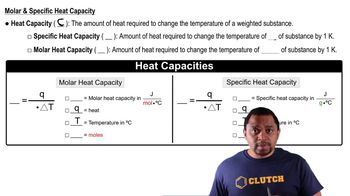
The heat equation is a formula used to calculate the amount of heat energy absorbed or released by a substance when its temperature changes. It is expressed as Q = mcΔT, where Q is the heat energy, m is the mass of the substance, c is the specific heat capacity, and ΔT is the change in temperature. This equation is fundamental in thermodynamics and helps in understanding energy transfer in physical processes.
Recommended video:
Guided course
02:19
Heat Capacity

Specific Heat Capacity

Specific heat capacity is a property of a substance that indicates the amount of heat required to change the temperature of one gram of the substance by one degree Celsius. It varies between different materials and is crucial for calculating heat transfer. In this case, the specific heat capacity of ethanol will be needed to determine the energy lost as it cools from 60.5 °C to −42.0 °C.
Recommended video:
Guided course
02:19
Heat Capacity

Energy Conversion (Joules to Calories)

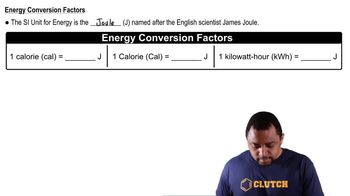
Energy conversion between joules and calories is important in thermodynamics, as these units measure energy in different contexts. One calorie is equivalent to approximately 4.184 joules. When calculating energy changes, it may be necessary to convert between these units to provide results in the desired format, such as joules for scientific contexts or calories for nutritional contexts.
Recommended video:
Guided course
01:14
Nature of Energy