
Textbook Question
Use the heat equation to calculate the energy, in joules and calories, for each of the following (see TABLE 3.11):
c. lost when 15.0 g of ethanol, C2H6O, cools from 60.5 °C to −42.0 °C
2934
views

 Verified step by step guidance
 2:09
2:09
 02:00
02:00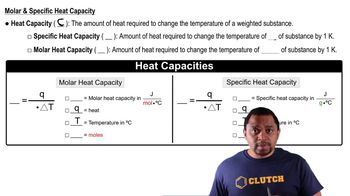 02:19
02:19Use the heat equation to calculate the energy, in joules and calories, for each of the following (see TABLE 3.11):
c. lost when 15.0 g of ethanol, C2H6O, cools from 60.5 °C to −42.0 °C
Using energy values from TABLE 3.8, determine each of the following:
c. If Charles consumes 1800 kcal per day, he will maintain his weight. Would he lose weight on his new diet?
Identify each of the following changes of state as melting, freezing, sublimation, or deposition:
d. Frost (ice) forms on the walls of a freezer unit of a refrigerator.
Identify each of the following changes of state as melting, freezing, sublimation, or deposition:
a. Dry ice in an ice-cream cart disappears.
Using the values for the heat of fusion, specific heat of water, and/or heat of vaporization, calculate the amount of heat energy in each of the following:
c. kilojoules needed to melt 24.0 g of ice at 0 °C, warm the liquid to 100 °C, and change it to steam at 100 °C
Identify each of the following changes of state as melting, freezing, sublimation, or deposition:
b. Snow on the ground turns to liquid water.