Pearson+ LogoPearson+ Logo
Ch.5 Nuclear Chemistry
Timberlake - Chemistry: An Introduction to General, Organic, and Biological Chemistry 13th Edition
Timberlake13th EditionChemistry: An Introduction to General, Organic, and Biological ChemistryISBN: 9780134421353Not the one you use?Change textbook
Chapter 5, Problem 63d

Complete each of the following nuclear equations:
d. 23m12Mg → ? + 00γ

Verified step by step guidance
1
Step 1: Identify the type of nuclear reaction. In this case, the presence of ⁰₀γ indicates that this is a gamma emission reaction. Gamma emission typically occurs when a nucleus transitions from an excited state to a lower energy state without changing the number of protons or neutrons.
Step 2: Write the initial isotope involved in the reaction. The given isotope is ²³ᵐ₁₂Mg, where the 'm' indicates that the magnesium nucleus is in an excited state.
Step 3: Recognize that gamma emission does not alter the atomic number (Z) or the mass number (A) of the nucleus. Therefore, the resulting nucleus will still be magnesium (Mg) with the same mass number (23) and atomic number (12).
Step 4: Write the complete nuclear equation. The excited magnesium isotope (²³ᵐ₁₂Mg) transitions to its ground state (²³₁₂Mg) and emits a gamma photon (⁰₀γ).
Step 5: Verify the equation for conservation of mass number and atomic number. The mass number (23) and atomic number (12) remain unchanged on both sides of the equation, confirming that the equation is balanced.

Verified video answer for a similar problem:

This video solution was recommended by our tutors as helpful for the problem above.
Video duration:
1m
Was this helpful?

Key Concepts

Here are the essential concepts you must grasp in order to answer the question correctly.

Nuclear Equations

Nuclear equations represent the transformation of atomic nuclei during radioactive decay or nuclear reactions. They show the initial and final states of the nucleus, including the particles emitted or absorbed. Understanding how to balance these equations is crucial, as it involves accounting for the conservation of mass and charge.
Recommended video:
Guided course
01:13
Thermochemical Equations

Gamma Radiation

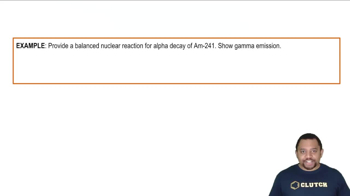
Gamma radiation is a form of electromagnetic radiation emitted during nuclear reactions, characterized by high energy and no mass or charge. It often accompanies other types of decay, such as alpha or beta decay, and serves to release excess energy from a nucleus. Recognizing gamma radiation's role helps in understanding the stability of the resulting nucleus.
Recommended video:
Guided course
02:53
Gamma Emission Concept 2

Isotopes and Isomeric States

Isotopes are variants of a chemical element that have the same number of protons but different numbers of neutrons, leading to different mass numbers. Isomeric states, like ²³ᵐ₁₂Mg, indicate a specific energy state of an isotope. Understanding these concepts is essential for predicting the products of nuclear reactions and the stability of the resulting isotopes.
Recommended video: