Pearson+ LogoPearson+ Logo
Ch.5 Nuclear Chemistry
Timberlake - Chemistry: An Introduction to General, Organic, and Biological Chemistry 13th Edition
Timberlake13th EditionChemistry: An Introduction to General, Organic, and Biological ChemistryISBN: 9780134421353Not the one you use?Change textbook
Chapter 5, Problem 11c

Match the type of radiation (1 to 3) with each of the following statements:
1. alpha particle
2. beta particle
3. gamma radiation
c. can be very harmful if ingested

Verified step by step guidance
1
Understand the types of radiation: Alpha particles (1) are heavy and consist of two protons and two neutrons, beta particles (2) are high-energy electrons, and gamma radiation (3) is electromagnetic radiation with high energy.
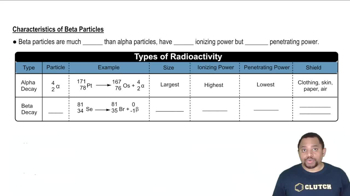
Recall the properties of alpha particles: They are large and have low penetration power, but they can cause significant damage if ingested due to their high ionizing ability.
Consider beta particles: They are smaller and have moderate penetration power, but their ionizing ability is less than alpha particles.
Evaluate gamma radiation: It has the highest penetration power but the lowest ionizing ability compared to alpha and beta particles.
Match the statement 'can be very harmful if ingested' with alpha particles (1), as their high ionizing ability makes them particularly dangerous when inside the body.

Verified video answer for a similar problem:

This video solution was recommended by our tutors as helpful for the problem above.
Video duration:
2m
Was this helpful?

Key Concepts

Here are the essential concepts you must grasp in order to answer the question correctly.

Alpha Particles

Alpha particles are positively charged particles consisting of two protons and two neutrons, essentially helium nuclei. They have low penetration power and can be stopped by a sheet of paper or the outer layer of human skin. However, if ingested or inhaled, they can cause significant damage to internal tissues due to their high mass and charge, making them particularly harmful in such scenarios.
Recommended video:
Guided course
01:33
Alpha Decay Concept 2

Beta Particles

Beta particles are high-energy, high-speed electrons or positrons emitted during radioactive decay. They have greater penetration power than alpha particles, capable of passing through paper but can be stopped by materials like plastic or glass. While they can cause damage to living tissues, their harm is generally less severe than that of alpha particles when ingested, as they are less ionizing.
Recommended video:
Guided course
01:26
Beta Decay Example 1

Gamma Radiation

Gamma radiation consists of high-energy electromagnetic waves emitted from the nucleus of a radioactive atom. Unlike alpha and beta particles, gamma rays have no mass or charge, allowing them to penetrate most materials, including human tissue. This makes gamma radiation particularly dangerous, as it can cause cellular damage and increase cancer risk, especially when exposure is prolonged or at high doses.
Recommended video:
Guided course
02:53
Gamma Emission Concept 2