Pearson+ LogoPearson+ Logo
Ch.7 Chemical Quantities and Reactions
Timberlake - Chemistry: An Introduction to General, Organic, and Biological Chemistry 13th Edition
Timberlake13th EditionChemistry: An Introduction to General, Organic, and Biological ChemistryISBN: 9780134421353Not the one you use?Change textbook
Chapter 7, Problem 39d

Balance each of the following chemical equations:
d. Al(s) + HCl(aq) → H2(g) + AlCl3(aq)

Verified step by step guidance
1
Step 1: Write the unbalanced chemical equation: Al(s) + HCl(aq) → H₂(g) + AlCl₃(aq).
Step 2: Identify the number of atoms of each element on both sides of the equation. On the reactant side, you have 1 Al atom, 1 H atom (from HCl), and 1 Cl atom. On the product side, you have 1 Al atom, 2 H atoms (from H₂), and 3 Cl atoms (from AlCl₃).
Step 3: Balance the aluminum (Al) atoms first. Since there is 1 Al atom on both sides, aluminum is already balanced.
Step 4: Balance the chlorine (Cl) atoms. To balance the 3 Cl atoms in AlCl₃, place a coefficient of 3 in front of HCl: Al(s) + 3HCl(aq) → H₂(g) + AlCl₃(aq).
Step 5: Balance the hydrogen (H) atoms. On the reactant side, there are now 3 H atoms from HCl. On the product side, H₂ contains 2 H atoms. To balance, place a coefficient of 3/2 in front of H₂, or alternatively, multiply the entire equation by 2 to eliminate fractions: 2Al(s) + 6HCl(aq) → 3H₂(g) + 2AlCl₃(aq).

Verified video answer for a similar problem:

This video solution was recommended by our tutors as helpful for the problem above.
Video duration:
5m
Was this helpful?

Key Concepts

Here are the essential concepts you must grasp in order to answer the question correctly.

Chemical Equation

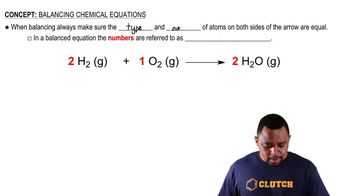
A chemical equation represents a chemical reaction using symbols and formulas. It shows the reactants on the left side and the products on the right, separated by an arrow. Balancing a chemical equation ensures that the number of atoms for each element is the same on both sides, adhering to the law of conservation of mass.
Recommended video:
Guided course
01:32
Balancing Chemical Equations (Simplified) Concept 1

Balancing Chemical Equations

Balancing chemical equations involves adjusting the coefficients of the reactants and products to ensure that the total number of atoms of each element is equal on both sides of the equation. This process may require trial and error, and it often starts with the most complex molecule or the element that appears in the least number of compounds.
Recommended video:
Guided course
01:32
Balancing Chemical Equations (Simplified) Concept 1

Stoichiometry

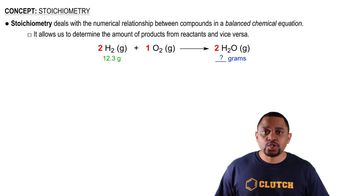
Stoichiometry is the branch of chemistry that deals with the quantitative relationships between the substances involved in a chemical reaction. It allows chemists to calculate the amounts of reactants needed or products formed based on the balanced equation, facilitating predictions about the outcomes of reactions.
Recommended video:
Guided course
01:16
Stoichiometry