
Pearson+ LogoPearson+ Logo
Ch.8 Gases
Timberlake - Chemistry: An Introduction to General, Organic, and Biological Chemistry 13th Edition
Timberlake13th EditionChemistry: An Introduction to General, Organic, and Biological ChemistryISBN: 9780134421353Not the one you use?Change textbook
Chapter 8, Problem 78a

A mixture of nitrogen (N2) and helium has a volume of 250 mL at 30 °C and a total pressure of 745 mmHg.
a. If the partial pressure of helium is 32 mmHg, what is the partial pressure of the nitrogen?

Verified step by step guidance
1
Step 1: Recall Dalton's Law of Partial Pressures, which states that the total pressure of a gas mixture is the sum of the partial pressures of the individual gases. Mathematically, this is expressed as: Ptotal = PHe + PN₂, where Ptotal is the total pressure, PHe is the partial pressure of helium, and PN₂ is the partial pressure of nitrogen.
Step 2: Identify the given values from the problem. The total pressure of the gas mixture is 745 mmHg, and the partial pressure of helium is 32 mmHg.
Step 3: Rearrange Dalton's Law equation to solve for the partial pressure of nitrogen: PN₂ = Ptotal - PHe.
Step 4: Substitute the known values into the equation: PN₂ = 745 - 32 mmHg.
Step 5: Perform the subtraction to determine the partial pressure of nitrogen. The result will give you the value of PN₂ in mmHg.

Verified video answer for a similar problem:

This video solution was recommended by our tutors as helpful for the problem above.
Video duration:
2m
Was this helpful?

Key Concepts

Here are the essential concepts you must grasp in order to answer the question correctly.

Dalton's Law of Partial Pressures

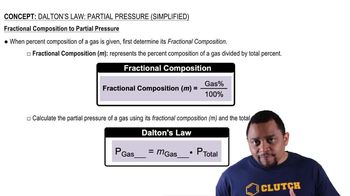
Dalton's Law states that in a mixture of gases, the total pressure exerted is equal to the sum of the partial pressures of each individual gas. This principle allows us to calculate the pressure of one gas in a mixture if we know the total pressure and the partial pressures of the other gases present.
Recommended video:
Guided course
01:02
Dalton's Law: Partial Pressure (Simplified) Concept 3

Partial Pressure

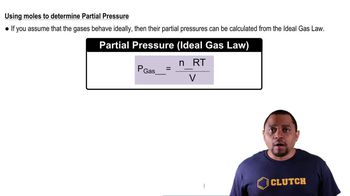
Partial pressure refers to the pressure that a single gas in a mixture would exert if it occupied the entire volume alone at the same temperature. It is a crucial concept for understanding gas behavior in mixtures and is calculated using the formula: P_partial = P_total - P_other_gases.
Recommended video:
Guided course
00:48
Dalton's Law: Partial Pressure (Simplified) Concept 2

Gas Laws

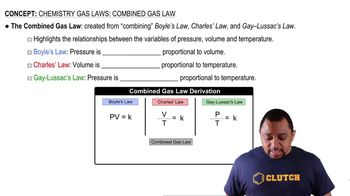
Gas laws describe the relationships between pressure, volume, temperature, and the number of moles of a gas. In this context, understanding how these variables interact helps in solving problems related to gas mixtures, particularly when applying the ideal gas law or Dalton's Law.
Recommended video:
Guided course
01:43
Chemistry Gas Laws: Combined Gas Law