Pearson+ LogoPearson+ Logo
Ch.8 Gases
Timberlake - Chemistry: An Introduction to General, Organic, and Biological Chemistry 13th Edition
Timberlake13th EditionChemistry: An Introduction to General, Organic, and Biological ChemistryISBN: 9780134421353Not the one you use?Change textbook
Chapter 8, Problem 7d

A tank contains oxygen (O2) at a pressure of 2.00 atm. What is the pressure in the tank in terms of the following units?
d. kPa

Verified step by step guidance
1
Identify the relationship between atm (atmospheres) and kPa (kilopascals). The conversion factor is 1 atm = 101.325 kPa.
Write the conversion equation: Pressure in kPa = Pressure in atm × Conversion factor.
Substitute the given pressure in atm (2.00 atm) into the equation. This gives: Pressure in kPa = 2.00 atm × 101.325 kPa/atm.
Perform the multiplication to calculate the pressure in kPa. Ensure that the units of atm cancel out, leaving the result in kPa.
Verify the result for significant figures. Since the given pressure (2.00 atm) has 3 significant figures, the final answer should also be reported with 3 significant figures.

Verified video answer for a similar problem:

This video solution was recommended by our tutors as helpful for the problem above.
Video duration:
50s
Was this helpful?

Key Concepts

Here are the essential concepts you must grasp in order to answer the question correctly.

Pressure Units

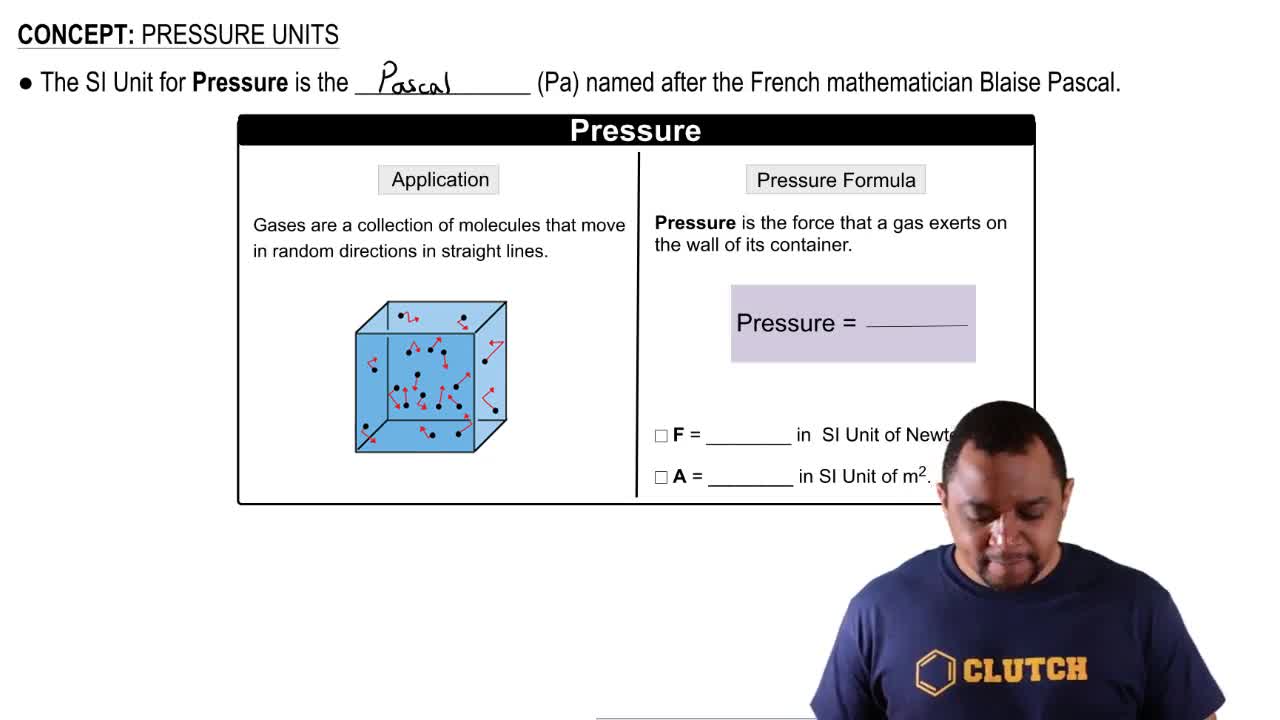
Pressure is a measure of force applied per unit area, and it can be expressed in various units, including atmospheres (atm), kilopascals (kPa), and others. Understanding how to convert between these units is essential for solving problems related to gas behavior and properties.
Recommended video:
Guided course
01:15
Pressure Units Concept 1

Conversion Factor

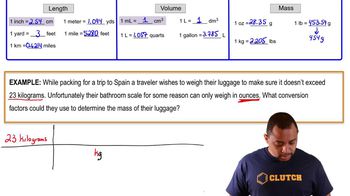
To convert pressure from one unit to another, a conversion factor is used. For example, 1 atm is equivalent to 101.325 kPa. Knowing this conversion factor allows for accurate calculations when changing pressure measurements from atm to kPa.
Recommended video:
Guided course
03:45
Conversion Factors (Simplified) Example 2

Ideal Gas Law

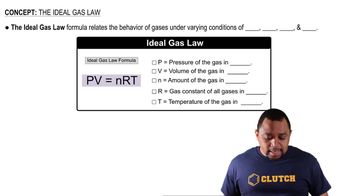
The Ideal Gas Law (PV=nRT) relates pressure (P), volume (V), temperature (T), and the number of moles (n) of a gas. While not directly needed for the conversion in this question, understanding this law provides context for why pressure measurements are important in gas-related calculations.
Recommended video:
Guided course
01:15
The Ideal Gas Law Concept 1