A tank contains oxygen (O2) at a pressure of 2.00 atm. What is the pressure in the tank in terms of the following units? b. lb/in.2
Verified step by step guidance
1
Understand the problem: We are tasked with converting the pressure of oxygen in the tank from atmospheres (atm) to pounds per square inch (lb/in²). This requires using a conversion factor between these two units of pressure.
Recall the conversion factor: 1 atm is equivalent to 14.7 lb/in². This is a standard conversion factor used in pressure unit conversions.
Set up the conversion: Multiply the given pressure in atm (2.00 atm) by the conversion factor (14.7 lb/in² per 1 atm). This can be expressed mathematically as:
Perform the multiplication: Multiply the numerical values to determine the pressure in lb/in². Ensure that the units of atm cancel out, leaving only lb/in² as the final unit.
Verify the result: Double-check the calculation and ensure the units are consistent. The final pressure should be expressed in lb/in² with the appropriate number of significant figures based on the given data (2.00 atm has 3 significant figures).
Verified video answer for a similar problem:
This video solution was recommended by our tutors as helpful for the problem above
Video duration:
1m
Play a video:
Was this helpful?
Key Concepts
Here are the essential concepts you must grasp in order to answer the question correctly.
Pressure Units
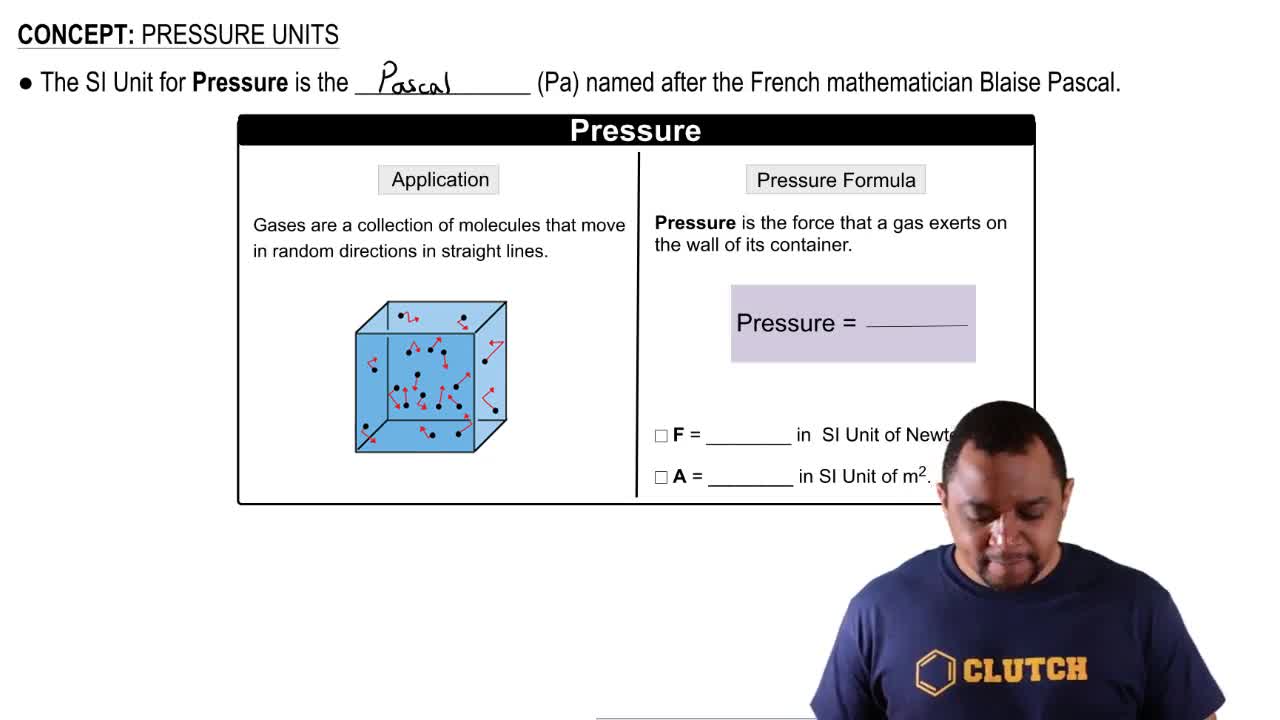
Pressure is a measure of force applied per unit area. Common units for pressure include atmospheres (atm), pounds per square inch (lb/in²), and pascals (Pa). Understanding how to convert between these units is essential for solving problems involving pressure in different contexts.
Unit conversion is the process of converting a quantity expressed in one set of units to another. For pressure, converting from atmospheres to pounds per square inch requires knowing the conversion factor, which is 1 atm = 14.696 lb/in². Mastery of unit conversion is crucial for accurately interpreting and solving scientific problems.
Gas laws describe the behavior of gases under various conditions of pressure, volume, and temperature. While this question focuses on pressure conversion, understanding the ideal gas law (PV=nRT) can provide context for how pressure relates to other properties of gases, which is important in broader applications.