Pearson+ LogoPearson+ Logo
Ch.8 Gases
Timberlake - Chemistry: An Introduction to General, Organic, and Biological Chemistry 13th Edition
Timberlake13th EditionChemistry: An Introduction to General, Organic, and Biological ChemistryISBN: 9780134421353Not the one you use?Change textbook
Chapter 8, Problem 1c

Use the kinetic molecular theory of gases to explain each of the following:
c. Gases have low densities.

Verified step by step guidance
1
The kinetic molecular theory of gases states that gas particles are in constant, random motion and are widely spaced relative to their size. This means that the majority of the volume occupied by a gas is empty space.
Density is defined as mass per unit volume (\( \text{Density} = \frac{\text{Mass}}{\text{Volume}} \)). Since gases occupy a large volume due to the significant amount of empty space between particles, the denominator (volume) in the density equation is very large.
The mass of a gas is relatively small compared to the large volume it occupies. This results in a very low value for density when the mass is divided by the large volume.
The low density of gases can also be observed experimentally. For example, gases like oxygen or nitrogen are much less dense than liquids or solids because their particles are not closely packed together.
In summary, the low density of gases is a direct consequence of the large amount of empty space between gas particles, as described by the kinetic molecular theory of gases.

Verified video answer for a similar problem:

This video solution was recommended by our tutors as helpful for the problem above.
Video duration:
1m
Was this helpful?

Key Concepts

Here are the essential concepts you must grasp in order to answer the question correctly.

Kinetic Molecular Theory

The kinetic molecular theory (KMT) describes the behavior of gases in terms of particles in constant motion. It posits that gas particles are far apart, move freely, and collide elastically with each other and the walls of their container. This theory helps explain various gas properties, including pressure, temperature, and volume, by relating them to the motion and energy of the gas molecules.
Recommended video:
Guided course
01:19
Kinetic Molecular Theory Concept 1

Density of Gases

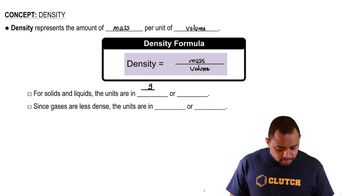
Density is defined as mass per unit volume. Gases have low densities compared to liquids and solids because their particles are spaced much farther apart. This large distance between particles results in a lower mass per unit volume, which is why gases can occupy a larger volume and are less dense than other states of matter.
Recommended video:

Effect of Temperature and Pressure

Temperature and pressure significantly influence the behavior of gases. According to KMT, increasing temperature causes gas particles to move faster and spread further apart, which can decrease density. Conversely, increasing pressure compresses gas particles closer together, potentially increasing density, but gases still remain less dense than liquids and solids due to their inherent molecular structure.
Recommended video:
Guided course
00:33
Standard Temperature and Pressure Concept 1