
Pearson+ LogoPearson+ Logo
Ch.9 Solutions
Timberlake - Chemistry: An Introduction to General, Organic, and Biological Chemistry 13th Edition
Timberlake13th EditionChemistry: An Introduction to General, Organic, and Biological ChemistryISBN: 9780134421353Not the one you use?Change textbook
Chapter 9, Problem 117d

A solution is prepared with 70.0 g of HNO3 and 130.0 g of H2O. The HNO3 solution has a density of 1.21 g/mL. (9.4)
d. What is the molarity (M) of the solution?

Verified step by step guidance
1
Step 1: Calculate the number of moles of HNO₃ in the solution. Use the molar mass of HNO₃ (63.01 g/mol) and the formula: \( \text{moles of HNO₃} = \frac{\text{mass of HNO₃}}{\text{molar mass of HNO₃}} \).
Step 2: Determine the total mass of the solution by adding the mass of HNO₃ (70.0 g) and the mass of H₂O (130.0 g).
Step 3: Calculate the volume of the solution using the given density (1.21 g/mL) and the total mass of the solution. Use the formula: \( \text{volume of solution (mL)} = \frac{\text{total mass of solution (g)}}{\text{density (g/mL)}} \). Convert the volume to liters (L) by dividing by 1000.
Step 4: Calculate the molarity (M) of the solution using the formula: \( M = \frac{\text{moles of solute}}{\text{volume of solution (L)}} \). Substitute the values for moles of HNO₃ and volume of the solution in liters.
Step 5: Ensure the units are consistent and verify the calculation for accuracy. The final molarity will be expressed in moles per liter (mol/L).

Verified video answer for a similar problem:

This video solution was recommended by our tutors as helpful for the problem above.
Video duration:
4m
Was this helpful?

Key Concepts

Here are the essential concepts you must grasp in order to answer the question correctly.

Molarity

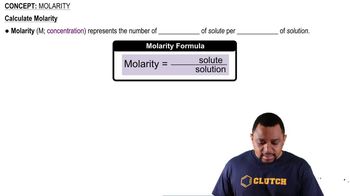
Molarity (M) is a measure of concentration defined as the number of moles of solute per liter of solution. It is calculated using the formula M = moles of solute / volume of solution in liters. Understanding molarity is essential for determining how concentrated a solution is, which is crucial in various chemical reactions and processes.
Recommended video:

Density

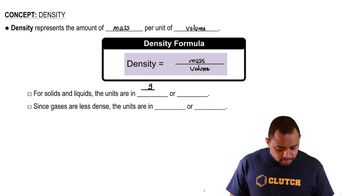
Density is the mass of a substance per unit volume, typically expressed in grams per milliliter (g/mL) for liquids. In this context, the density of the HNO₃ solution allows us to convert the mass of the solution into volume, which is necessary for calculating molarity. Knowing the density helps in understanding how much solute is present in a given volume of solution.
Recommended video:

Moles of Solute

Moles of solute refer to the amount of a substance measured in moles, where one mole is equivalent to 6.022 x 10²³ particles (atoms, molecules, etc.). To find the moles of HNO₃ in the solution, we use its molar mass, which allows us to relate the mass of the solute to the number of moles. This is a critical step in calculating molarity, as it directly influences the concentration of the solution.
Recommended video: