Back
Back
Problem 1
If the envelope of a particular virus were unstable outside the host's body, which of the following statements would you expect to be true concerning this virus?
a. It would be a dsRNA virus.
b. It would be transmitted by intimate contact.
c. Touching a doorknob would easily transmit it.
d. That virus would eventually cease to be a threat to the population.
Problem 2
For which of the following reasons are most animal poxviruses unable to infect humans?
a. Affected animals are not in frequent contact with humans.
b. The human immune system makes it impossible for the foreign viral particles to
reproduce effectively.
c. Attachment to human cells is unlikely.
d. Human cells lack the necessary enzymes for infection.
Problem 3
The initial flat, red skin lesions of poxviruses are called____.
a. macules
b. papules
c. pustules
d. pocks
Problem 4
Which of the following statements is true concerning variola major?
a. It carries a mortality rate of less than 1%.
b. It affects internal organs before appearing on the skin.
c. The causative virus has been totally eradicated from Earth.
d. The skin lesions it causes are smooth, waxy, tumorlike nodules on the face.
Problem 5
Which of the following herpesvirus infections would be potentially most serious?
a. A whitlow
b. Ocular herpes
c. Shingles
d. Cytomegalovirus in a fetus
Problem 6
A man experienced a laboratory accident in which he was infected with adenovirus. What signs or symptoms might he exhibit?
a. Sore throat
b. Headache
c. Pinkeye
d. All of the above
Problem 7
Which of the following is an inflammatory condition of the liver?
a. Fifth disease
b. PML
c. Seed warts
d. Hepatitis
Problem 8
Which of the following statements is false?
a. B19 virus is the primary parvovirus of humans.
b. Erythema infectiosum is caused by a parvovirus.
c. In children, parvovirus infections are accompanied by a high mortality rate.
d. Parvovirus infection in humans results in infectious reddening of the skin.
Problem 9
A distinguishing feature of poxvirus is _____.
a. its large size
b. a polyhedral capsid
c. the type of RNA it contains
d. the production of several types of warts
Problem 10
Monkeypox has been diagnosed in several humans in the Democratic Republic of the Congo. What might be recommended to prevent further risk of infection?
a. Catch the monkeys for inoculation with monkeypox vaccine.
b. Remove infected tissues from humans with chemicals, by surgery, or by freezing.
c. Reinstate smallpox vaccinations for the country's population.
d. The diagnosis must have been incorrect because humans are unaffected by
monkeypox.
Problem 11
Which of the following viral families is most likely to contain viruses that exist in a latent
state in humans?
a. Herpesviridae
b. Poxviridae
c. Adenoviridae
d. Parvoviridae
Problem 12
DNA viruses in which of the following families are relatively large and thus potentially
well suited for the introduction of genetic material in gene therapy?
a. Herpesviridae
b. Poxviridae
c. Papillomaviridae
d. Hepadnaviridae
Problem 13
Being habitually careful not to touch or rub your eyes with unwashed hands would reduce your risk of contracting_____.
a. chickenpox
b. infectious mononucleosis
c. seed warts
d. a cold
Problem 14
Human herpesvirus 2 _____.
a. can cause genital herpes
b. may infect a baby at birth
c. causes about 10% of cold sores
d. all of the above
Problem 15
Epstein-Barr virus _____.
a. can be asymptomatic
b. causes mononucleosis
c. can cause cancer
d. all of the above
Problem 1
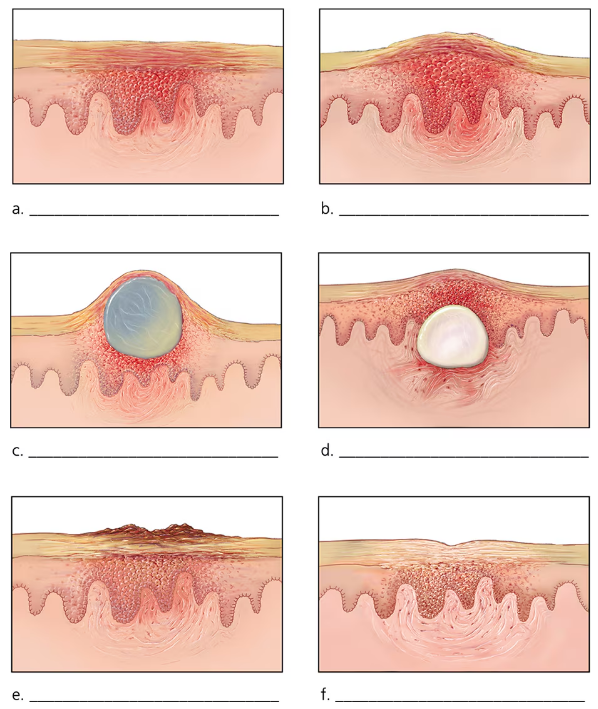
Label the successive stages of skin lesions as exemplified by smallpox.
Problem 2
Name the disease shown in each photo.
a. <IMAGE>
b. <IMAGE>
c. <IMAGE>
d. <IMAGE>
e. <IMAGE>
f. <IMAGE>
Problem 1
The Smith family seems to get fever blisters regularly. Suggest an explanation for this observation.
Problem 2
You have been given a large grant to do postgraduate research on live smallpox viruses. Where in the world would you find samples?
Problem 3
What was the difference in the effects of variola major and variola minor?
Problem 4
What observation led scientists to understand the relationship between shingles and chickenpox?
Problem 5
Most of the world’s population in less developed and developing countries have been infected with EBV human herpesvirus 4 by age one and show no ill effects, even where medical care is poor. In contrast, individuals in industrialized countries are ordinarily infected after puberty, and these older patients tend to have more severe reactions to infection despite better overall health and access to medical care. Explain this apparent paradox.