Ch. 3 - Introduction to Prokaryotic Cells
Norman-McKay- Microbiology: Basic and Clinical Principles 2nd Edition
Norman-McKay2nd EditionMicrobiology: Basic and Clinical PrinciplesISBN: 9780137661619Not the one you use?Change textbook
Chapter 3, Problem 9

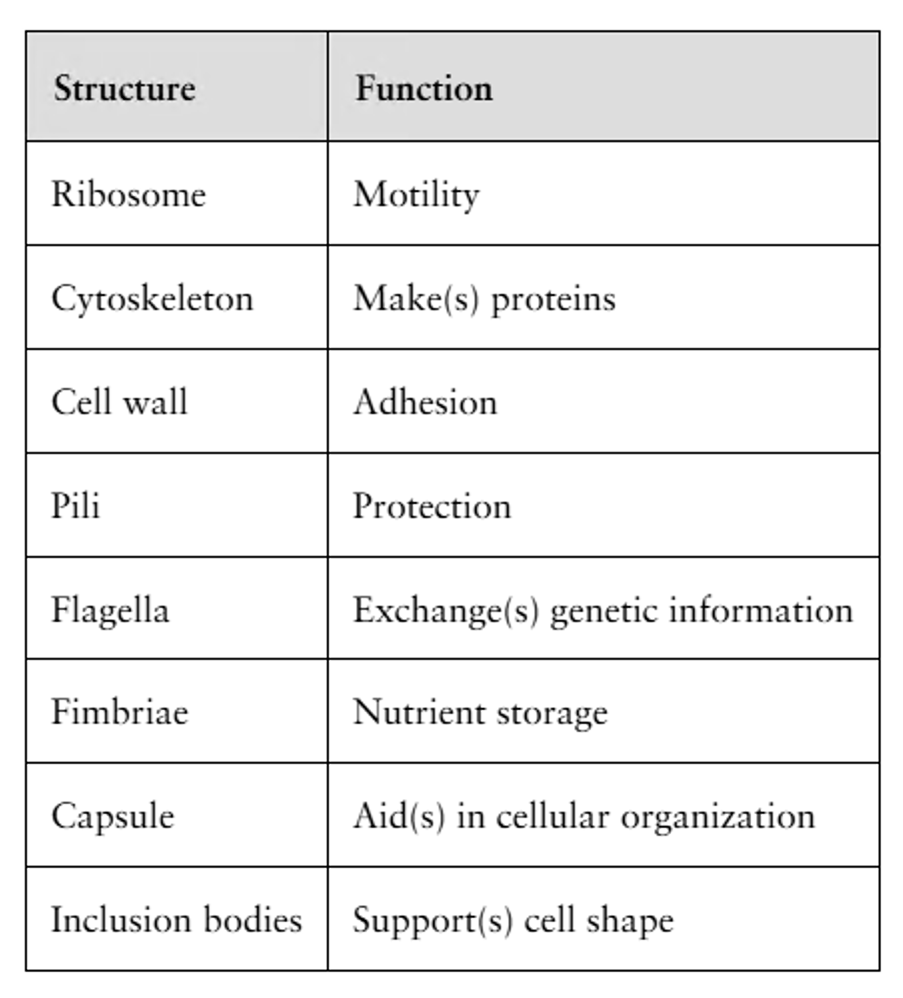
Match the cellular structures to their functions. Many statements will be used more than once; some structures may be matched to more than one functional description.
Table matching cellular structures like ribosome and flagella to their respective functions such as motility and protection.

Verified step by step guidance
1
Identify each cellular structure listed in the problem and write down its name clearly.
Recall the primary functions associated with each cellular structure based on microbiology knowledge. For example, know that the cell wall provides structural support and protection, the flagella are involved in motility, and ribosomes are responsible for protein synthesis.
Create a list or table where you pair each structure with its known functions. Remember that some functions may apply to multiple structures, and some structures may have multiple functions.
Use the process of elimination and logical reasoning to match each function to the correct structure(s). For instance, if a function involves movement, it likely corresponds to flagella or pili, not the cell wall.
Double-check your matches by reviewing the definitions and roles of each structure to ensure accuracy and completeness before finalizing your answers.

Verified video answer for a similar problem:

This video solution was recommended by our tutors as helpful for the problem above.
Video duration:
3m
Was this helpful?

Key Concepts

Here are the essential concepts you must grasp in order to answer the question correctly.

Cellular Structures and Their Functions

Understanding the specific roles of cellular structures such as the nucleus, ribosomes, mitochondria, and cell membrane is essential. Each organelle has distinct functions like genetic information storage, protein synthesis, energy production, and selective permeability, which are fundamental to cell operation.
Recommended video:
Guided course
06:04
Functional Groups

Structure-Function Relationship in Cells

The principle that the shape and composition of a cellular structure determine its function helps in matching organelles to their roles. For example, the folded inner membrane of mitochondria increases surface area for energy production, illustrating how structure supports function.
Recommended video:
Guided course
05:42
Cell Junctions

Repetition and Overlap of Functions

Some cellular structures perform multiple functions, and certain functions may be shared by different organelles. Recognizing this overlap is important for correctly matching structures to functions, as it reflects the complexity and integration within cellular processes.
Recommended video:
Guided course
06:04
Functional Groups