Pearson+ LogoPearson+ Logo
Ch. 16 - Innate Immunity: Nonspecific Defenses of the Host
Tortora - Microbiology: An Introduction 14th Edition
Tortora14th EditionMicrobiology: An IntroductionISBN: 9780138200398Not the one you use?Change textbook
Chapter 16, Problem 2

Define inflammation, and list its characteristics.

Verified step by step guidance
1
Start by defining inflammation as a biological response of body tissues to harmful stimuli such as pathogens, damaged cells, or irritants. It is a protective mechanism aimed at removing the injurious stimuli and initiating the healing process.
Explain that inflammation involves a complex series of events including the activation of immune cells, release of chemical mediators, and changes in blood flow.
List the classic characteristics of inflammation, often remembered by the Latin terms: 'Rubor' (redness), 'Tumor' (swelling), 'Calor' (heat), 'Dolor' (pain), and 'Functio laesa' (loss of function).
Describe each characteristic briefly: redness and heat result from increased blood flow; swelling is due to accumulation of fluid; pain arises from chemical mediators stimulating nerve endings; and loss of function can occur due to pain and tissue damage.
Summarize that these characteristics collectively help in identifying inflammation and understanding its role in the body's defense and repair mechanisms.

Verified video answer for a similar problem:

This video solution was recommended by our tutors as helpful for the problem above.
Video duration:
1m
Was this helpful?

Key Concepts

Here are the essential concepts you must grasp in order to answer the question correctly.

Definition of Inflammation

Inflammation is the body's protective response to injury, infection, or harmful stimuli. It involves immune cells, blood vessels, and molecular mediators working together to eliminate the cause of cell injury and initiate tissue repair.
Recommended video:
Guided course
03:09
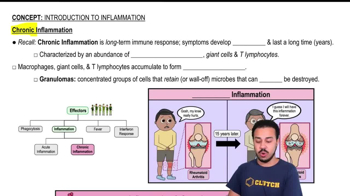
Chronic Inflammation

Characteristics of Inflammation

The classic signs of inflammation include redness, heat, swelling, pain, and loss of function. These result from increased blood flow, vascular permeability, and the accumulation of immune cells at the affected site.
Recommended video:
Guided course
03:09
Chronic Inflammation

Purpose and Outcomes of Inflammation

Inflammation aims to remove harmful agents and damaged tissue, promoting healing. While acute inflammation is beneficial and self-limiting, chronic inflammation can lead to tissue damage and disease.
Recommended video:
Guided course
03:09
Chronic Inflammation