Pearson+ LogoPearson+ Logo
Ch. 4 - Functional Anatomy of Prokaryotic and Eukaryotic Cells
Tortora - Microbiology: An Introduction 14th Edition
Tortora14th EditionMicrobiology: An IntroductionISBN: 9780138200398Not the one you use?Change textbook
Chapter 4, Problem 4

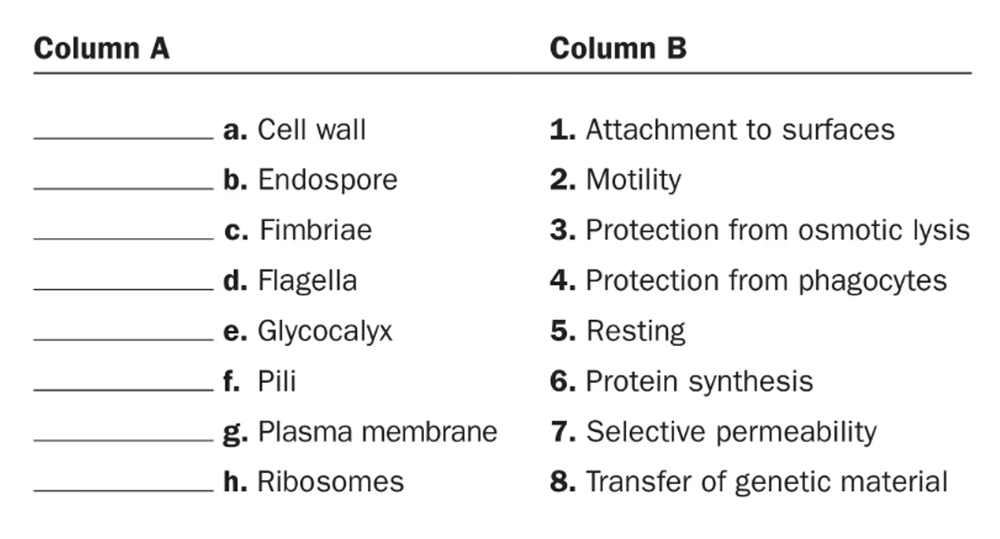
Match the structures in column A to their functions in column B.
Matching exercise listing prokaryotic cell structures in column A and their functions in column B to pair correctly.

Verified step by step guidance
1
Identify each structure listed in column A by recalling its key characteristics and role in microbiology. For example, if the structure is a bacterial flagellum, recognize it as a motility organelle.
Review the functions listed in column B carefully, understanding what each function entails. For instance, functions might include motility, protection, genetic exchange, or nutrient absorption.
Match each structure to the function that best corresponds to its known biological role. For example, match the flagellum to motility, the capsule to protection against host defenses, and pili to genetic exchange or attachment.
Use elimination to help with difficult matches by ruling out functions that clearly do not fit a given structure based on your microbiology knowledge.
Double-check your matches by considering the overall context and ensuring that each structure-function pair makes sense biologically and aligns with standard microbiology concepts.

Verified video answer for a similar problem:

This video solution was recommended by our tutors as helpful for the problem above.
Video duration:
2m
Was this helpful?

Key Concepts

Here are the essential concepts you must grasp in order to answer the question correctly.

Microbial Cell Structures

Understanding the various structures of microbial cells, such as the cell wall, plasma membrane, flagella, pili, and ribosomes, is essential. Each structure has a specific role in the cell's survival, movement, or reproduction, which helps in correctly matching them to their functions.
Recommended video:
Guided course
05:59
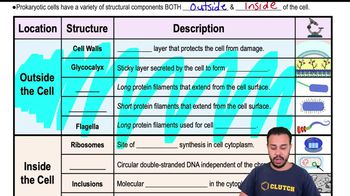
Overview of Prokaryotic Cell Structure

Functions of Microbial Cell Components

Each microbial structure performs distinct functions like protection, nutrient transport, motility, or protein synthesis. Knowing these functions allows one to link the physical structure to its biological role, facilitating accurate matching in the question.
Recommended video:
Guided course
05:42
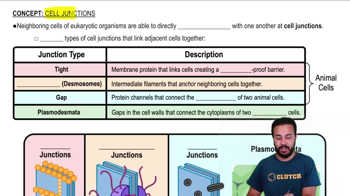
Cell Junctions

Structure-Function Relationship in Microbiology

The principle that the shape and composition of a microbial structure determine its function is key. Recognizing this relationship helps in predicting the function based on structural features, which is critical for answering matching questions involving cell components.
Recommended video:
Guided course
05:59
Symbiotic Relationships
Related Practice
Textbook Question

Use the following choices to answer the following question.

a. No change will result; the solution is isotonic.

b. Water will move into the cell.

c. Water will move out of the cell.

d. The cell will undergo osmotic lysis.

e. Sucrose will move into the cell from an area of higher concentration to one of lower concentration.


Which statement best describes what happens when a gram-positive bacterium is placed in distilled water and penicillin?

691
views
Textbook Question

Draw the bacterial shapes listed in (a), (b), and (c). Then draw the shapes in (d), (e), and (f), showing how they are special conditions of a, b, and c, respectively.

a. Spiral

b. Bacillus

c. Coccus

d. Spirochetes

e. Staphylococci

f. Streptobacilli

761
views
Textbook Question

Use the following choices to answer the following question.

a. No change will result; the solution is isotonic.

b. Water will move into the cell.

c. Water will move out of the cell.

d. The cell will undergo osmotic lysis.

e. Sucrose will move into the cell from an area of higher concentration to one of lower concentration.


Which statement best describes what happens when a gram-negative bacterium is placed in distilled water and penicillin?

546
views
Textbook Question

Use the following choices to answer the following question.

a. No change will result; the solution is isotonic.

b. Water will move into the cell.

c. Water will move out of the cell.

d. The cell will undergo osmotic lysis.

e. Sucrose will move into the cell from an area of higher concentration to one of lower concentration.


Which statement best describes what happens when a gram-positive bacterium is placed in an aqueous solution of lysozyme and 10% sucrose?

647
views
Textbook Question

Which of the following statements best describes what happens to a cell exposed to polymyxins that destroy phospholipids?

a. In an isotonic solution, nothing will happen.

b. In a hypotonic solution, the cell will lyse.

c. Water will move into the cell.

d. Intracellular contents will leak from the cell.

e. Any of the above might happen.

651
views
Textbook Question

Why is an endospore called a resting structure? Of what advantage is an endospore to a bacterial cell?

976
views