Predict the products, including stereochemistry where appropriate, for the m-chloroperoxybenzoic acid epoxidations of the following alkenes. a. cis-hex-2-ene b. trans-hex-2-ene
Verified step by step guidance
1
Identify the reagent and its function: m-Chloroperoxybenzoic acid (mCPBA) is a peracid commonly used for epoxidation of alkenes. It reacts with the double bond of an alkene to form an epoxide (a three-membered cyclic ether). The reaction is stereospecific, meaning the stereochemistry of the starting alkene is retained in the product.
Analyze the structure of the first alkene (cis-hex-2-ene): This is a cis-alkene, meaning the two substituents on the double bond are on the same side. When mCPBA reacts with this alkene, the epoxide will form with the substituents on the same side of the three-membered ring, preserving the cis stereochemistry.
Predict the product for cis-hex-2-ene: The product will be a cis-epoxide, where the two substituents (on carbons 2 and 3 of the original alkene) remain on the same side of the epoxide ring. Represent this stereochemistry clearly in your drawing or model.
Analyze the structure of the second alkene (trans-hex-2-ene): This is a trans-alkene, meaning the two substituents on the double bond are on opposite sides. When mCPBA reacts with this alkene, the epoxide will form with the substituents on opposite sides of the three-membered ring, preserving the trans stereochemistry.
Predict the product for trans-hex-2-ene: The product will be a trans-epoxide, where the two substituents (on carbons 2 and 3 of the original alkene) are on opposite sides of the epoxide ring. Again, represent this stereochemistry clearly in your drawing or model.
Verified video answer for a similar problem:
This video solution was recommended by our tutors as helpful for the problem above
Video duration:
5m
Play a video:
0 Comments
Key Concepts
Here are the essential concepts you must grasp in order to answer the question correctly.
Epoxidation
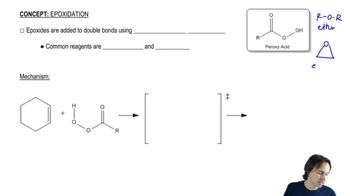
Epoxidation is a chemical reaction that converts alkenes into epoxides, which are three-membered cyclic ethers. This reaction typically involves the addition of an oxygen atom across the double bond of the alkene, resulting in a highly reactive epoxide. m-Chloroperoxybenzoic acid (m-CPBA) is a common reagent used for this transformation, providing a source of peracid that facilitates the formation of the epoxide.
Stereochemistry refers to the study of the spatial arrangement of atoms in molecules and how this affects their chemical behavior. In the context of epoxidation, the stereochemistry of the starting alkene influences the stereochemical outcome of the epoxide product. For example, the configuration of substituents around the double bond in cis and trans alkenes leads to different stereochemical products upon epoxidation.
Cis and trans isomerism is a form of geometric isomerism where the relative positioning of substituents around a double bond differs. In cis isomers, substituents are on the same side of the double bond, while in trans isomers, they are on opposite sides. This distinction is crucial in predicting the products of reactions like epoxidation, as it affects the stereochemical outcome and the overall reactivity of the alkenes involved.