Ch. 30 - Inductance, Electromagnetic Oscillations, and AC Circuits
Giancoli Douglas - Physics for Scientists and Engineers 5th edition
Giancoli Douglas5th editionPhysics for Scientists and EngineersISBN: 9780137488179Not the one you use?Change textbook
Chapter 29, Problem 7

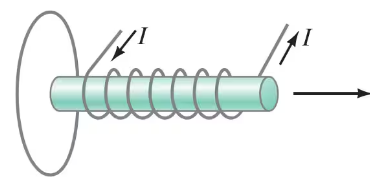
(II) If the solenoid in Fig. 29–47 is being pulled away from the loop shown, in what direction is the induced current in the loop? Explain.

Verified step by step guidance
1
Step 1: Understand the concept of electromagnetic induction. When the magnetic flux through a loop changes, an induced current is generated in the loop according to Faraday's Law. The direction of the induced current is determined by Lenz's Law, which states that the induced current will oppose the change in magnetic flux.
Step 2: Analyze the situation described in the problem. The solenoid is being pulled away from the loop, which means the magnetic field produced by the solenoid is decreasing in the region of the loop. This reduction in magnetic flux through the loop is the key factor causing the induced current.
Step 3: Apply Lenz's Law. Since the magnetic flux is decreasing, the induced current in the loop will act to oppose this decrease. To do so, the induced current will create its own magnetic field in the same direction as the original field produced by the solenoid.
Step 4: Determine the direction of the induced current. Use the right-hand rule to find the direction of the induced current. If the solenoid's magnetic field points into the plane of the loop, the induced current will flow in a direction that maintains this field (clockwise or counterclockwise depending on the orientation).
Step 5: Conclude the direction of the induced current. Based on the orientation of the solenoid's magnetic field and the application of Lenz's Law, the induced current in the loop will flow in the direction that opposes the decrease in magnetic flux caused by the solenoid being pulled away.

Verified video answer for a similar problem:

This video solution was recommended by our tutors as helpful for the problem above.
Video duration:
2m
Was this helpful?

Key Concepts

Here are the essential concepts you must grasp in order to answer the question correctly.

Faraday's Law of Electromagnetic Induction

Faraday's Law states that a change in magnetic flux through a circuit induces an electromotive force (EMF) in that circuit. The induced EMF is proportional to the rate of change of the magnetic flux. This principle is fundamental in understanding how moving a magnet or changing the magnetic field around a conductor can generate electric current.
Recommended video:
Guided course
09:26
Faraday's Law

Lenz's Law

Lenz's Law provides the direction of the induced current resulting from electromagnetic induction. It states that the induced current will flow in a direction that opposes the change in magnetic flux that produced it. This means that if the magnetic field through a loop is decreasing, the induced current will flow in a direction that attempts to maintain the original magnetic field.
Recommended video:

Magnetic Flux

Magnetic flux is a measure of the quantity of magnetism, taking into account the strength and the extent of a magnetic field. It is defined as the product of the magnetic field strength and the area through which the field lines pass, and it is affected by the angle between the field lines and the surface area. Understanding magnetic flux is crucial for analyzing how changes in the magnetic environment affect induced currents in nearby conductors.
Recommended video:
Guided course
04:52
Magnetic Flux
Related Practice
Textbook Question

At a given instant, a 2.4-A current flows in the wires connected to a parallel-plate capacitor. What is the rate at which the electric field is changing between the plates if the square plates are 1.60 cm on a side?

994
views

Textbook Question

(III) A toroid has a rectangular cross section as shown in Fig. 30–26. Show that the self-inductance is


L=μ0N2h2πlnr2r1L = \(\frac{\mu_0 N^2 h}{2\pi}\) \(\ln\) \(\frac{r_2}{r_1}\)


where N is the total number of turns and r₁, r₂ and h are the dimensions shown in Fig. 30–26. [Hint: Use Ampère’s law to get B as a function of r inside the toroid, and integrate.]


1606
views
Textbook Question

A coil has 3.25-Ω resistance and 440-mH inductance. If the current is 3.00 A and is increasing at a rate of 3.15 A/s, what is the potential difference across the coil at this moment?

1841
views
Textbook Question

(III) A long straight wire and a small rectangular wire loop lie in the same plane, Fig. 30–25. Determine the mutual inductance in terms of 𝓁₁, 𝓁₂, and w. Assume the wire is very long compared to 𝓁₁, 𝓁₂, and w, and that the rest of its circuit is very far away compared to 𝓁₁, 𝓁₂, and w.

1349
views
Textbook Question

(II) Part of a single rectangular loop of wire with dimensions shown in Fig. 29–49 is situated inside a region of uniform magnetic field of 0.650 T. The total resistance of the loop is 0.250 Ω. Calculate the force required to pull the loop from the field (to the right) at a constant velocity of 3.40 m/s. Neglect gravity.

1504
views