Ch 36: Special Relativity
Knight Calc - Physics for Scientists and Engineers 5th Edition
Knight Calc5th EditionPhysics for Scientists and EngineersISBN: 9780137344796Not the one you use?Change textbook
Chapter 36, Problem 62a

Derive a velocity transformation equation for uy and u'y. Assume that the reference frames are in the standard orientation with motion parallel to the x- and x'-axes.

Verified step by step guidance
1
Start by considering the standard Lorentz transformation equations for the coordinates and time between two inertial reference frames S and S', where S' moves with a velocity v relative to S along the x-axis. The transformations are: x' = γ(x - vt)y' = yz' = zt' = γ(t - vx/c²), where γ = 1/√(1 - v²/c²).
Define the velocity components in the S frame as ux = dx/dt and uy = dy/dt. Similarly, in the S' frame, the velocity components are u'x = dx'/dt' and u'y = dy'/dt'.
Use the chain rule to express the velocity components in S' in terms of the Lorentz transformations. For the y-component, substitute y' = y and t' = γ(t - vx/c²). This gives u'y = dy'/dt' = dy/dt / γ(1 - vux/c²).
Recognize that ux and uy are the velocity components in the S frame. Substitute these into the equation for u'y to express the transformed y-velocity in terms of the original velocities and the relative velocity v between the frames.
The final velocity transformation equation for the y-component is: u'y = uy / γ(1 - vux/c²). This equation shows how the y-component of velocity transforms between two reference frames in relative motion along the x-axis.

Key Concepts

Here are the essential concepts you must grasp in order to answer the question correctly.

Reference Frames

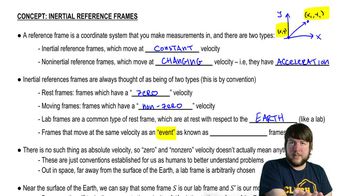
Reference frames are coordinate systems used to measure and describe the position and motion of objects. In physics, particularly in relativity, different observers may have different reference frames, which can affect the measurements of time, length, and velocity. Understanding how to transform quantities between these frames is crucial for analyzing motion in different contexts.
Recommended video:
Guided course
14:10
Inertial Reference Frames

Velocity Transformation

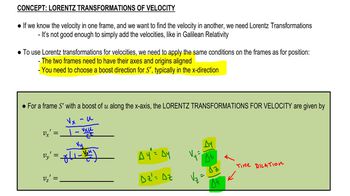
Velocity transformation refers to the mathematical relationships that allow the conversion of velocity measurements from one reference frame to another. In special relativity, these transformations account for the effects of relative motion at significant fractions of the speed of light, ensuring that the laws of physics remain consistent across different observers. The transformation equations help in deriving how velocities perceived in one frame relate to those in another.
Recommended video:
Guided course
13:39
Lorentz Transformations of Velocity

Lorentz Transformation

The Lorentz transformation is a set of equations that relate the space and time coordinates of events as observed in different inertial frames moving at constant velocity relative to each other. These transformations are fundamental in special relativity, allowing for the calculation of how time and space are perceived differently by observers in relative motion. They are essential for deriving velocity transformation equations, particularly when dealing with relativistic speeds.
Recommended video:
Guided course
13:39
Lorentz Transformations of Velocity
Related Practice
Textbook Question

A rocket is fired from the earth to the moon at a speed of 0.990c. Let two events be 'rocket leaves earth' and 'rocket hits moon.' In the earth's reference frame, calculate ∆x, ∆t, and the spacetime interval s for these events.

52
views
Textbook Question

The half-life of a muon at rest is 1.5 μs. Muons that have been accelerated to a very high speed and are then held in a circular storage ring have a half-life of 7.5 μs. What is the total energy of a muon in the storage ring? The mass of a muon is 207 times the mass of an electron.

115
views
Textbook Question

Let's examine whether or not the law of conservation of momentum is true in all reference frames if we use the Newtonian definition of momentum: px = mux. Consider an object A of mass 3m at rest in reference frame S. Object A explodes into two pieces: object B, of mass m, that is shot to the left at a speed of c/2 and object C, of mass 2m, that, to conserve momentum, is shot to the right at a speed of c/4. Suppose this explosion is observed in reference frame S' that is moving to the right at half the speed of light. Use the Lorentz velocity transformation to find the velocities and the Newtonian momenta of B and C in S'.

114
views
Textbook Question

Two rockets approach each other. Each is traveling at 0.75c in the earth's reference frame. What is the speed, as a fraction of c, of one rocket relative to the other?

1292
views
Textbook Question

A rocket traveling at 0.50c sets out for the nearest star, Alpha Centauri, which is 4.3 ly away from earth. It will return to earth immediately after reaching Alpha Centauri. What distance will the rocket travel and how long will the journey last according to (a) stay-at-home earthlings and (b) the rocket crew? (c) Which answers are the correct ones, those in part a or those in part b?

44
views
Textbook Question

A rocket is fired from the earth to the moon at a speed of 0.990c. Let two events be 'rocket leaves earth' and 'rocket hits moon.' Repeat your calculations of part a if the rocket is replaced with a laser beam.

46
views