
Ch. 29 - Electromagnetic Induction and Faraday's Law
Giancoli Douglas - Physics for Scientists and Engineers 5th edition
Giancoli Douglas5th editionPhysics for Scientists and EngineersISBN: 9780137488179Not the one you use?Change textbook
Chapter 28, Problem 48

A model-train transformer plugs into 120-V ac and draws 0.35 A while supplying 6.5 A to the train.
(a) What voltage is present across the tracks?
(b) Is the transformer step-up or step-down?

Verified step by step guidance
1
Step 1: Use the principle of conservation of power for an ideal transformer. The input power (primary side) is equal to the output power (secondary side). The formula is: Pin = Pout, where P = V × I (voltage times current).
Step 2: Calculate the output voltage across the tracks using the formula: Vout = Vin × (Iin / Iout). Substitute the given values: Vin = 120 V, Iin = 0.35 A, and Iout = 6.5 A.
Step 3: Simplify the ratio (Iin / Iout) and multiply it by Vin to find Vout. This will give the voltage across the tracks.
Step 4: Determine whether the transformer is step-up or step-down by comparing the input voltage (Vin) to the output voltage (Vout). If Vout < Vin, it is a step-down transformer; otherwise, it is step-up.
Step 5: Conclude the solution by stating the calculated output voltage and whether the transformer is step-up or step-down based on the comparison in Step 4.

Verified video answer for a similar problem:

This video solution was recommended by our tutors as helpful for the problem above.
Video duration:
7m
Was this helpful?

Key Concepts

Here are the essential concepts you must grasp in order to answer the question correctly.

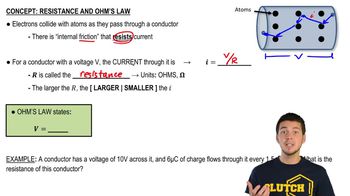
Ohm's Law

Ohm's Law states that the current (I) flowing through a conductor between two points is directly proportional to the voltage (V) across the two points and inversely proportional to the resistance (R) of the conductor. This relationship is expressed as V = I × R. Understanding this law is crucial for analyzing electrical circuits, including transformers, as it helps determine the voltage and current relationships.
Recommended video:
Guided course
03:07
Resistance and Ohm's Law

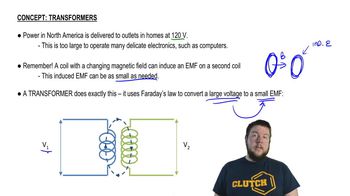
Transformer Basics

A transformer is an electrical device that transfers electrical energy between two or more circuits through electromagnetic induction. It consists of primary and secondary coils, and its operation is based on the principle that a changing current in the primary coil creates a changing magnetic field, inducing a voltage in the secondary coil. The voltage ratio between the primary and secondary coils determines whether the transformer is a step-up or step-down transformer.
Recommended video:

Power Conservation in Transformers

In an ideal transformer, the power input to the primary coil equals the power output from the secondary coil, expressed as P_primary = P_secondary. This means that the product of voltage and current remains constant, allowing for the calculation of unknown voltages or currents. This principle is essential for solving the given problem, as it helps determine the voltage across the tracks based on the current supplied to the train.
Recommended video: