

Ch. 35 - Diffraction
Giancoli Douglas - Physics for Scientists and Engineers 5th edition
Giancoli Douglas5th editionPhysics for Scientists and EngineersISBN: 9780137488179Not the one you use?Change textbook
Chapter 34, Problem 20

In a double-slit experiment, let d = 5.00D = 40.0λ. Compare (as a ratio) the intensity of the third-order interference maximum with that of the zero-order maximum.

Verified step by step guidance
1
Understand the problem: In a double-slit experiment, the intensity of the interference pattern is determined by the superposition of light waves from the two slits. The intensity at any point depends on the phase difference between the waves, which is influenced by the path difference and the slit separation (d). We are tasked with comparing the intensity of the third-order maximum (m = 3) to the zero-order maximum (m = 0).
Recall the formula for intensity in a double-slit experiment: The intensity at a point is proportional to the square of the amplitude of the resultant wave. The amplitude is given by: \( A = 2A_0 \cos(\phi/2) \), where \( \phi \) is the phase difference between the two waves. The intensity is then \( I = I_0 \cos^2(\phi/2) \), where \( I_0 \) is the maximum intensity.
Determine the phase difference \( \phi \): The phase difference is related to the path difference \( \Delta x \) by \( \phi = \frac{2\pi \Delta x}{\lambda} \), where \( \lambda \) is the wavelength of light. For the m-th order maximum, the path difference is \( m\lambda \), so \( \phi = \frac{2\pi m\lambda}{\lambda} = 2\pi m \).
Calculate the intensity ratio: For the zero-order maximum (m = 0), \( \phi = 0 \), so \( \cos^2(\phi/2) = \cos^2(0) = 1 \). For the third-order maximum (m = 3), \( \phi = 2\pi \times 3 = 6\pi \), and \( \cos^2(\phi/2) = \cos^2(3\pi) = \cos^2(\pi) = 1 \). Thus, the intensity ratio \( \frac{I_3}{I_0} = \frac{\cos^2(3\pi)}{\cos^2(0)} = 1 \).
Conclude: The intensity of the third-order maximum is equal to the intensity of the zero-order maximum, so the ratio is 1:1. This result arises because the cosine function is periodic, and \( \cos^2(\phi/2) \) repeats its values every \( 2\pi \).

Verified video answer for a similar problem:

This video solution was recommended by our tutors as helpful for the problem above.
Video duration:
5m
Was this helpful?

Key Concepts

Here are the essential concepts you must grasp in order to answer the question correctly.

Double-Slit Experiment

The double-slit experiment demonstrates the wave nature of light through the interference pattern created when coherent light passes through two closely spaced slits. When light waves overlap, they can constructively or destructively interfere, resulting in bright and dark fringes on a screen. This experiment is fundamental in understanding wave-particle duality and the principles of quantum mechanics.
Recommended video:
Guided course
12:00
Young's Double Slit Experiment

Interference Maximum

Interference maxima occur at specific angles where the path difference between light waves from the two slits is an integer multiple of the wavelength. The zero-order maximum is the central bright fringe, while higher-order maxima, like the third-order maximum, correspond to greater path differences. The intensity of these maxima varies, typically decreasing as the order increases due to factors like diffraction and the finite width of the slits.
Recommended video:
Guided course
03:47
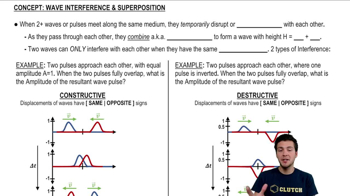
Wave Interference & Superposition

Intensity Ratio

The intensity of light at interference maxima is related to the amplitude of the waves involved. The intensity ratio between different orders of maxima can be calculated using the formula I_n/I_0 = (sin(β)/β)^2, where β is a function of the slit separation and wavelength. This ratio helps quantify how the brightness of the third-order maximum compares to the zero-order maximum, illustrating the effects of interference on light intensity.
Recommended video:
Guided course
02:32
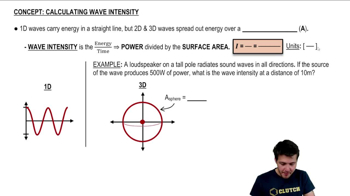
Wave Intensity
Related Practice
Textbook Question

(a) Derive an expression for the intensity in the interference pattern for three equally spaced slits. Express in terms of δ = 2πd sin θ / λ where d is the distance between adjacent slits and assume the slit width D ≈ λ.

(b) Show that there is only one secondary maximum between principal peaks.

1398
views
Textbook Question

Explain why the secondary maxima in the single-slit diffraction pattern do not occur precisely at β/2 = (m + 1/2)π where m = 1, 2, 3, ... Carefully and precisely plot the curves y = β/2 and y = tan β/2. From their intersections, determine the values of β for the first and second secondary maxima. What is the percent difference from β/2 = (m + 1/2)π?

88
views
Textbook Question

(III) Derive an expression for the intensity in the interference pattern for three equally spaced slits. Express in terms of δ = 2πd sin θ / λ where d is the distance between adjacent slits and assume the slit width D ≈ λ . Show that there is only one secondary maximum between principal peaks.

1551
views
Textbook Question

(a) Explain why the secondary maxima in the single-slit diffraction pattern do not occur precisely at β/2 = (m + 1/2)π where m = 1, 2, 3, ... .

(b) By differentiating Eq. 35–7 with respect to β show that the secondary maxima occur when β/2 satisfies the relation tan(β/2) = β/2.

(c) Carefully and precisely plot the curves y = β/2 and y = tan β/2. From their intersections, determine the values of β for the first and second secondary maxima. What is the percent difference from β/2 = (m + 1/2)π?

1503
views
Textbook Question

The nearest neighboring star to the Sun is about 4 light-years away. If a planet happened to be orbiting this star at an orbital radius equal to that of the Earth–Sun distance, what minimum diameter would an Earth-based telescope’s aperture have to be in order to obtain an image that resolved this star–planet system? Assume the light emitted by the star and planet has a wavelength of 550 nm.

86
views
Textbook Question

Two 0.010-mm-wide slits are 0.030 mm apart (center to center). Determine (a) the spacing between interference fringes for 520-nm light on a screen 1.0 m away and (b) the distance between the two diffraction minima on either side of the central maximum of the envelope.

74
views