Ch. 05 - Using Newton's Laws: Friction, Circular Motion, Drag Forces
Giancoli Douglas - Physics for Scientists and Engineers 5th edition
Giancoli Douglas5th editionPhysics for Scientists and EngineersISBN: 9780137488179Not the one you use?Change textbook
Chapter 5, Problem 3

Suppose you are standing on a train accelerating at 0.20 g. What minimum coefficient of static friction must exist between your feet and the floor if you are not to slide?

Verified step by step guidance
1
Identify the forces acting on you while standing on the accelerating train. These include the force of static friction (which prevents you from sliding) and the pseudo-force due to the train's acceleration.
Express the pseudo-force acting on you in terms of the train's acceleration. The pseudo-force is given by \( F_{pseudo} = m a \), where \( m \) is your mass and \( a \) is the train's acceleration. Here, \( a = 0.20 g \), where \( g \) is the acceleration due to gravity (\( g \approx 9.8 \, \text{m/s}^2 \)).
Recognize that the static friction force \( F_{friction} \) must balance the pseudo-force to prevent you from sliding. The maximum static friction force is given by \( F_{friction} = \mu_s F_{normal} \), where \( \mu_s \) is the coefficient of static friction and \( F_{normal} = m g \) is the normal force acting on you.
Set up the equation for equilibrium: \( \mu_s m g = m a \). Simplify this equation by canceling \( m \) on both sides, resulting in \( \mu_s = \frac{a}{g} \).
Substitute \( a = 0.20 g \) into the equation \( \mu_s = \frac{a}{g} \). This simplifies to \( \mu_s = 0.20 \). Thus, the minimum coefficient of static friction required is \( \mu_s = 0.20 \).

Verified video answer for a similar problem:

This video solution was recommended by our tutors as helpful for the problem above.
Video duration:
5m
Was this helpful?

Key Concepts

Here are the essential concepts you must grasp in order to answer the question correctly.

Acceleration

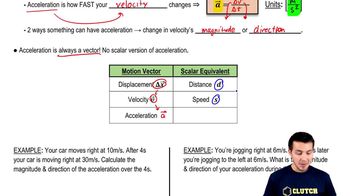
Acceleration is the rate of change of velocity of an object with respect to time. In this context, the train is accelerating at 0.20 g, where 'g' represents the acceleration due to gravity (approximately 9.81 m/s²). This means the train's acceleration is about 1.96 m/s², which affects the forces acting on a person standing inside the train.
Recommended video:
Guided course
05:47
Intro to Acceleration

Static Friction

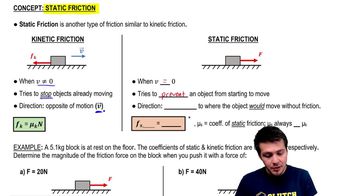
Static friction is the force that resists the initiation of sliding motion between two surfaces in contact. It is dependent on the normal force and the coefficient of static friction. To prevent sliding while the train accelerates, the static frictional force must be sufficient to counteract the inertial force experienced by the person due to the train's acceleration.
Recommended video:
Guided course
08:11
Static Friction & Equilibrium

Coefficient of Static Friction

The coefficient of static friction (μs) is a dimensionless value that represents the ratio of the maximum static frictional force to the normal force acting between two surfaces. It determines how much force is needed to overcome static friction. In this scenario, calculating the minimum coefficient of static friction is essential to ensure that the person does not slide as the train accelerates.
Recommended video:
Guided course
08:11
Static Friction & Equilibrium