Ch 07: Newton's Third Law
Knight Calc - Physics for Scientists and Engineers 5th Edition
Knight Calc5th EditionPhysics for Scientists and EngineersISBN: 9780137344796Not the one you use?Change textbook
Chapter 7, Problem 2b

A weightlifter stands up at constant speed from a squatting position while holding a heavy barbell across his shoulders. Identify the "system" on your interaction diagram.

Verified step by step guidance
1
Define the system: The system includes the weightlifter (his body) and the barbell he is holding. This is because we are analyzing the forces acting on both the weightlifter and the barbell as a combined system.
Identify external forces: The external forces acting on the system are the gravitational force (weight) acting downward on both the weightlifter and the barbell, and the normal force exerted by the ground upward on the weightlifter's feet.
Clarify internal forces: Internal forces include the forces within the weightlifter's body, such as the muscular forces exerted by his legs to lift his body and the barbell. These forces are internal to the system and do not affect the net external force.
State the motion condition: Since the weightlifter is moving at a constant speed, the system is in dynamic equilibrium. This means the net external force acting on the system is zero, as there is no acceleration.
Summarize the interaction diagram: The interaction diagram should show the system (weightlifter + barbell) with arrows representing the external forces: the downward gravitational force and the upward normal force. Internal forces are not shown in the interaction diagram as they cancel out within the system.

Verified video answer for a similar problem:

This video solution was recommended by our tutors as helpful for the problem above.
Was this helpful?

Key Concepts

Here are the essential concepts you must grasp in order to answer the question correctly.

System Definition

In physics, a 'system' refers to a specific portion of the universe chosen for analysis, which can include objects, forces, and interactions. In this context, the system encompasses the weightlifter and the barbell, as they are the primary subjects of interest in understanding the forces and motions involved.
Recommended video:
Guided course
06:48
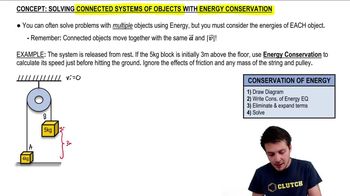
Systems Of Objects with Energy Conservation

Free Body Diagram

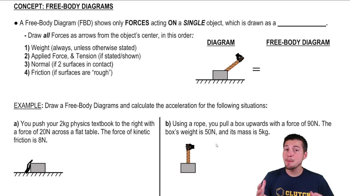
A free body diagram is a graphical representation used to visualize the forces acting on an object. For the weightlifter, this diagram would illustrate the gravitational force acting downward on the barbell and the weightlifter, as well as the normal force exerted by the ground, which balances these forces when the lifter moves at constant speed.
Recommended video:
Guided course
08:42
Free-Body Diagrams

Newton's Second Law

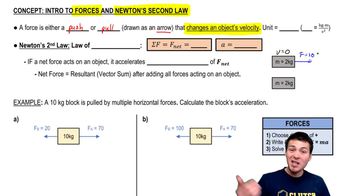
Newton's Second Law states that the acceleration of an object is directly proportional to the net force acting on it and inversely proportional to its mass. In this scenario, since the weightlifter is moving at constant speed, the net force is zero, indicating that the upward force exerted by the lifter equals the downward gravitational force acting on the barbell and his body.
Recommended video:
Guided course
06:54
Intro to Forces & Newton's Second Law