
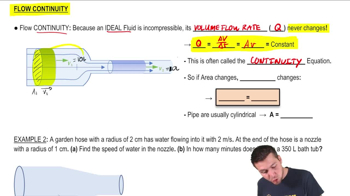
A fire hose exerts a force on the person holding it due to the water accelerating as it goes from the thicker hose out through the narrow nozzle. How much force is required to hold a 7.0-cm-diameter hose delivering 480 L/min through a 0.75-cm-diameter nozzle?
What must be the pressure difference between the two ends of a 1.6-km section of pipe, 29 cm in diameter, if it is to transport oil (ρ = 950 kg/m³, η=0.20 Pa⋅s) at a rate of 650 cm³/s?
Verified step by step guidance
Verified video answer for a similar problem:
Key Concepts
Bernoulli's Principle
Continuity Equation
Viscosity and Flow Rate
Estimate the diameter of a steel needle that can just barely remain on top of water due to surface tension. (See Figs. 13–38 and 13–39a, and Table 13–1.)
A common effect of surface tension is the ability of a liquid to rise up a narrow tube due to capillary action. Show that for a narrow tube of radius r placed in a liquid of density ρ and surface tension γ, the liquid in the tube will reach a height h = 2γ/ρgr above the level of the liquid outside the tube, where g is the gravitational acceleration. Assume that the liquid “wets” the tube and that the liquid surface is vertical at the contact with the inside of the tube.
If cholesterol buildup reduces the diameter of an artery by 25%, by what % will the blood flow rate be reduced, assuming the same pressure difference?
Estimate the air pressure inside a category 5 hurricane, where the wind speed is 300 km/h (Fig. 13–56).
<IMAGE>
A fish tank has dimensions 36 cm wide by 1.0 m long by 0.60 m high. If the filter should process all the water in the tank once every 2.5 h, what should the flow speed be in the 3.0-cm-diameter input tube for the filter?
