Ch 16: Traveling Waves
Knight Calc - Physics for Scientists and Engineers 5th Edition
Knight Calc5th EditionPhysics for Scientists and EngineersISBN: 9780137344796Not the one you use?Change textbook
Chapter 16, Problem 59

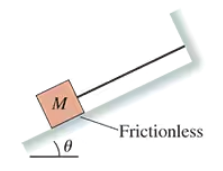
The string in FIGURE P16.59 has linear density μ. Find an expression in terms of M, μ, and θ for the speed of waves on the string.

Verified step by step guidance
1
Step 1: Begin by identifying the forces acting on the system. The block of mass M is on an inclined plane with angle θ, and the string is under tension due to the weight of the block. The tension in the string is caused by the component of the gravitational force acting along the incline.
Step 2: Write the expression for the tension in the string. The gravitational force acting on the block is given by F = M * g, where g is the acceleration due to gravity. The component of this force along the incline is T = M * g * sin(θ), which represents the tension in the string.
Step 3: Recall the formula for the speed of waves on a string. The speed of waves v is given by v = sqrt(T / μ), where T is the tension in the string and μ is the linear density of the string.
Step 4: Substitute the expression for tension into the wave speed formula. Replace T with M * g * sin(θ) in the formula for v, resulting in v = sqrt((M * g * sin(θ)) / μ).
Step 5: Simplify the expression to obtain the final formula for the speed of waves on the string. The speed of waves is v = sqrt((M * g * sin(θ)) / μ), which is expressed in terms of M, μ, and θ.

Verified video answer for a similar problem:

This video solution was recommended by our tutors as helpful for the problem above.
Video duration:
2m
Was this helpful?

Key Concepts

Here are the essential concepts you must grasp in order to answer the question correctly.

Wave Speed on a String

The speed of waves on a string is determined by the tension in the string and its linear density. The formula for wave speed (v) is given by v = √(T/μ), where T is the tension and μ is the linear density. Understanding how tension is affected by external forces, such as gravity acting on a mass on an incline, is crucial for deriving the wave speed in this scenario.
Recommended video:
Guided course
04:39
Energy & Power of Waves on Strings

Linear Density (μ)

Linear density (μ) is defined as the mass per unit length of a string, typically expressed in kg/m. It plays a significant role in wave mechanics, as it influences how quickly waves can propagate through the medium. In this problem, knowing the linear density allows us to relate the mass of the string to its physical properties and the resulting wave speed.
Recommended video:
Guided course
8:13
Intro to Density

Tension in the String

Tension in the string is the force exerted along the length of the string, which is crucial for wave propagation. In the context of the inclined plane, the tension can be derived from the gravitational force acting on the mass (M) and the angle (θ) of the incline. The vertical component of the gravitational force contributes to the tension, which directly affects the wave speed on the string.
Recommended video:
Guided course
04:39
Energy & Power of Waves on Strings
Related Practice
Textbook Question

A 1000 Hz sound wave traveling through 20°C air causes the pressure to oscillate around atmospheric pressure by ±0.050%. What is the maximum speed of an oscillating air molecule? Give your answer in mm/s.

1714
views

Textbook Question

FIGURE P16.57 shows a snapshot graph of a wave traveling to the right along a string at 45 m/s. At this instant, what is the velocity of points 1, 2, and 3 on the string?

2092
views
Textbook Question

A string that is under 50.0 N of tension has linear density 5.0 g/m. A sinusoidal wave with amplitude 3.0 cm and wavelength 2.0 m travels along the string. What is the maximum speed of a particle on the string?

1687
views
Textbook Question

LASIK eye surgery uses pulses of laser light to shave off tissue from the cornea, reshaping it. A typical LASIK laser emits a 1.0-mm-diameter laser beam with a wavelength of 193 nm. Each laser pulse lasts 15 ns and contains 1.0 mJ of light energy. During the very brief time of the pulse, what is the intensity of the light wave?

1899
views
Textbook Question

A sound wave is described by D(y,t)=(0.0200mm)×sin[(8.96rad/m)y+(3140rad/s)t+π/4rad]D(y, t) = (0.0200 \, \(\text{mm}\)) \(\times\) \(\sin\)[(8.96 \, \(\text{rad/m}\))y + (3140 \, \(\text{rad/s}\))t + \(\pi\)/4 \, \(\text{rad}\)], where yy is in mm and tt is in ss. Along which axis is the air oscillating?

1582
views
Textbook Question

A wave on a string is described by D(x,t)=(2.00cm)×sin[(12.57rad/m)x(638rad/s)t]D(x,t) = (2.00 \, \(\text{cm}\)) \(\times\) \(\sin\)[(12.57 \, \(\text{rad/m}\))x - (638 \, \(\text{rad/s}\)) t], where xx is in mm and tt in ss. The linear density of the string is 5.00 g/m5.00\(\text{ g/m}\). What are The maximum speed of a point on the string?

2151
views